Here is an Article about Carnival Girl, published in Meridian Magazine. The writer, Jennie Hansen, does a wonderful job explaining the complexities of the book. Enjoy this really great review!
Meridian Magazine: World War II, Carnival Life, and Family Relationships in Carnival Girl
Showing posts with label Mothers. Show all posts
Showing posts with label Mothers. Show all posts
Saturday, June 9, 2012

Wednesday, February 15, 2012
Meeting Verna Towne
Cortez was supposed to be a larger city, but to me it looked like the stage-setting of a Spaghetti Western. Again, the buildings and stores were flat and low, spread out with so much unused space around them that I was glad to be surrounded by the comforting metal of the car.
The hospital wasn’t any different. Low and spread out, we had to walk for what seemed like hours, instead of coming in and taking an elevator to the right section.
We entered a room with white walls. A single bed stood in a corner, and the winter sunlight streamed through a window onto the foot end of the bed. An older woman with fashionably slanted glasses, rhinestones on each side, lay propped up in the bed, watching a TV hanging on the wall.
She looked up and smiled.
“Mom,” Gary said and rushed into her embrace.
Mrs. Towne smiled at me then turned to Gary. “Is this your new bride?”
Gary introduced us and I held out my hand for the customary German handshake.
“Come closer,” she said, and when I did, she reached out with both arms and hugged me.
I was taken aback by the too sudden familiarity of my new mother-in-law, but at the same time, the instant friendliness of my new American relatives pleased and disarmed me. Verna’s warm smile and soft touch made me like her immediately.
In Germany, her actions would have been too forward, but I kept telling myself I was in Colorado now, and Americans were supposed to be much friendlier.
“It’s good to meet you, Sonja,” Mrs. Towne said while holding my hand. “Welcome to my family. And thanks for giving me a grandchild.”
She patted my six-month pregnant belly. In Germany I would have been inspected and talked about for a few days, and maybe eventually gotten close to my new mother-in-law, but, I reminded myself, I’m not in Germany anymore.
Gary’s mom was doing well. She told me about her operation. I didn’t understand everything, but I did learn that she would stay in the hospital another week, however, to make sure her ulcers were all gone and she was healthy enough to come home.
Monday, February 13, 2012
Verna Towne

Verna Towne in 2006. We all love and miss her!
Verna Towne passed away last night, at 91 years of age. Even
though we should have been prepared, the family is reeling. Grandma was a great
and wonderful influence in all our lives, and for me, she had become a true
mother. The next few blog posts will be about her and about me getting to know
and love her. Here’s the first one.
Culture Shock
It was dark
when we arrived at my husband’s parents home in Colorado. I was jetlagged and
my head kept dropping onto my chest on the ride from the airport. I had only
one desire, to find a bed and sleep.
Gary
opened the car door and helped me out of the car. A large dog came up to me,
alternately barking and wagging its tail. I shrank back. That dog was larger
than a German shepherd, with thick, dark fur. He took a sniff at my extended
belly, and I expected him to take a bite out of me. But before Gary could even
say a word, the dog quit barking and licked my hand.
“Triton
smells the baby inside you,” Gary said petting the dog who now had lost
interest in me and was smiling a doggie smile at my husband. “He is never
friendly to strangers, but somehow he knows you’re part of the family.”
A
stranger to me, an older version of Gary, came from the house, hugged me and
led me into his home.
Gary
showed me a bedroom and finally I could sleep.
The
next day, I watched Gary make breakfast. He turned on the faucet over the
kitchen sink and let it run. Soon the water coming out steamed. I was
surprised. This house had running hot water. In my apartment in Germany, I had
to heat the water on the stove when I wanted it hot.
Gary
said, “If you’re up to it, let’s go visit Mom in the hospital in Cortez.”
I
had slept long and well, and was up to it.
I followed my husband out of the house, and
that’s when culture shock really set in.
*****
Tomorrow I'll post more
about culture shock and the first time I met Verna Towne .
Sunday, February 12, 2012
Elfriede Markus

Elfriede Edel as a Young Widow
Mutti’s mother was a widow when Mutti was four years old.
She was young and pretty, and wanted to have a man in her life. She went out
dancing and having fun while leaving the little girl all alone at home.
Eventually she married again, and her name changed from Elfriede Edel to
Elfriede Markus.
Elfriede was very young when Mutti was born. She was far
from her family and didn’t really know how to raise a child. In many ways, Mutti
was emotionally and physically abused. She told me a few years ago that parents
of that time hit their children and rarely praised them as a matter of course.

My wedding in 1973. Elfried and Max are in the front, with my baby brother Michael between them. I'm right behind Max, and my father is next to me with my sister Josefa. Mutti is on the right behind Elfriede, with my husband Gary next to her.
And that’s the reason why I never met my grandmother Elfriede
until my wedding at 23. When Mutti was still small, she swore she’d never hit
her children. When the war was finally over, Mutti was six months pregnant, so
she and Vati got married as soon as they could, with no one of Mutti’s family
in attendance.
A year or so later, before traveling to Berlin became very
difficult, Mutti and Vati visited Max and Elfriede Markus in Berlin. Then they
took their circus back to Hessen, the heartland of Germany. Mutti had no
contact with her mother. They never wrote each other. Telephoning was out of
the question because of our constant travels. My grandmother must have tried to
visit when I was small, but I don’t remember that. When we were older, Mutti
told us children that she had no wish to have her mother close to her children,
because she was afraid Elfriede would hit us. She didn’t want that, and she
didn’t want to deal with her mother.
However, by the time I was 23, they had contacted each other
again, and my grandmother was invited, and came, to my wedding. I never met
her again after that.
But even though I grew up without grandparents, I hope I
have become a pretty good grandmother! I enjoy being a grandmother very much!
Tuesday, January 31, 2012
Fahrtenschwimmer (Swimming, Part Two)

My Fahrtenschwimmer decal looked a lot like this one
When I was a teenager, Mutti left the Carnival with us girls
and little Michael. We stayed in the caravan home in Wetzlar for about one
year, then moved into an apartment in a tiny town close to Wetzlar. I rode my bicycle
to Wetzlar to work every morning.
I was seventeen by that time, but because I had left school
at fourteen, and because of our constant traveling I had never made any
friends.
A seventeen-year-old without friends is a rare thing!
Something had to take the place of friends, and I did find two things that
delighted me to no end. I had converted to the LDS church two years earlier,
and in our tiny branch in Wetzlar I made a friend, a girl with whom I’m still
in contact today. However, she lived in Giessen, about twelve miles from
Wetzlar, and even further away from the tiny town I lived in, so we saw each
other only occasionally, and when we took the train to visit each other.
The other thing that I delighted in doing might have found
me friends, but because of my background, which taught me to be careful and not
make friends because I would just lose them again, and because of a natural
shyness of strangers, it never did.
But I did have fun! I went to the indoor pool in Wetzlar
every week or so, to swim, teach myself to dive, jump off the board, and in
general delight in playing in the water. Most of the kids in the pool were
younger and I kept to myself for the above mentioned reasons. I learned to swim
on my back and under water, but I never could teach myself the crawl, which is
so commonly taught here in the States.
One day, I was playing along the rim of the pool when the
life saver on duty, and older man, at least twenty-five, bent down and talked
to me. “I see you here a lot. Would you be interested in getting your Fahrtenschwimmer?”
I had heard of Fahrtenschwimmer
before, but wasn’t sure if I could do it. “What exactly would I have to do to
get it?”
“You have to be able to swim for fifteen minutes without
touching the bottom or the sides and dive for ten meters and bring up one of
these blocks.” He held up a black rubber block with a handle. “They’re only
five pounds. Also, you have to dive off the high board and swim on your back
without using your arms.”
“I don’t know.” I frowned at the man. “It sounds hard.”
“It isn’t. I’ve seen you do all of that just for fun. If you
pass, you’ll get your certification. You could go on from there, take another
test, and even become a lifesaver, if you want.”
That sounded great to me. “How much does it cost?”
“It’s only five Marks. I have regular times when I administer the test. You’ll be certified right afterward. So how about it?”
“Yes. I want to do it.”
“Come with me to my office, and we’ll set you up.”
Two weeks later, on a Saturday when I didn’t have to work, I
took my Fahrtenschwimmer test and
passed it. I received a little decal and a blue booklet certifying that I passed and could
go on from there.
At home, I showed it to Mutti, but she was busy with Michael
and just glanced at it. I put it away, intending to take the next test, which
included forty-five minutes of swimming and some diving. But things got in the
way, and I never went back for it.
However, I still delight in swimming and water play.
Monday, January 30, 2012
Swimming, Part One

I only know how to swim breast stroke, and here is why!
I love going to aqua aerobics in the mornings. I enjoy
moving in the water, swimming a lap or two and the companionship of the other
gym members. But I only swim in breast stroke. Here’s why.
When I was little, in the winters, we attended the same
school for about four to five months One day in late November when I attended
fifth grade I came home, looking for Mutti. She was in the living room,
reading.
“Do I have a swimsuit, Mutti?”
She looked up from her book. “I think you do. Look in your
drawer. Why?”
“The teacher said that we will have swimming lessons every
Wednesday afternoon, right before we come home. I need to bring a swimsuit.”
“Okay. See what you can find.”
I dropped my satchel onto the kitchen bench and went into
the bedroom, pulled out the drawer and dug through mine and Josefa’s underwear.
Yes, there was a suit. It was a bright, cheery blue. I pulled it out, and while
I was alone, took off my clothes and tried it on. It was a little tight, but
still fit. “I found one, Mutti,” I called through the half open door as I put my
clothes on again.
On Wednesday the teacher herded us into a school bus and
took us to the local indoor pool. “Here are the dressing rooms,” he announced
as we walked through the wet and bleachy smelling hallway. He pointed to one
side. “This one is for the girls.” Go change into your suits, girls, and wait
in the pool area.”
We dressed in the common area, and in no time were in the
pool area. The teacher was already there. After all the children were assembled
and the teacher had done a headcount (We were about sixteen children) he asked,
“Which of you already knows how to swim?”
Three boys and four girls raised their hands. “Okay. You can
go to the deep end and play until I’m done with the beginners. Then I’ll teach
you some tricks.” He turned to the rest of us. “Line up in the water, please,
hands on the rim.”
I followed the children into the pool, hanging on to the
rim. The water was surprisingly warm, not as cold as it usually was in the
outdoors pools we sometimes played in, in the summers.
Teacher had us line up on the rim of the pool and showed us
how to move our legs in the breast stroke pattern. He left us to practice and
went to work with the swimmers.
I enjoyed my swimming classes every week and practiced with
enthusiasm. But I was a little too wary of the water to let go and let the
water carry me. When classes were over in February, I still hadn’t learned how
to swim, but I knew the breast stroke movements very well.
That summer I had the opportunity to visit an outdoor pool
in one of the towns we held our carnival in. I played around in the shallow
end, enjoying the cold water and the feeling of cleanliness it gave me.
“Let’s play together,” a local girl suggested, and we chased
each other around in the water. Eventually she caught me and pushed me under. I
was scared, but when I came up again she was laughing. “Your turn,” she said,
and I dunked her. I pretended I liked to be dunked too, and by the end of our
play my fear had gone.
As we ventured into a little deeper water, I pushed off the
ground and actually floated. I remembered my breast stroke movements and before
I knew it, I was swimming. I had a wonderful time practicing my swimming for
two days and then it got cold and started raining, and I couldn’t go back to
the pool.
I forgot that girl’s name, but I still remember how I wished
I could have stayed her friend and not leave for the next town and the next
carnival.
Tomorrow I’ll talk more about swimming
Saturday, January 28, 2012
Bath Time!
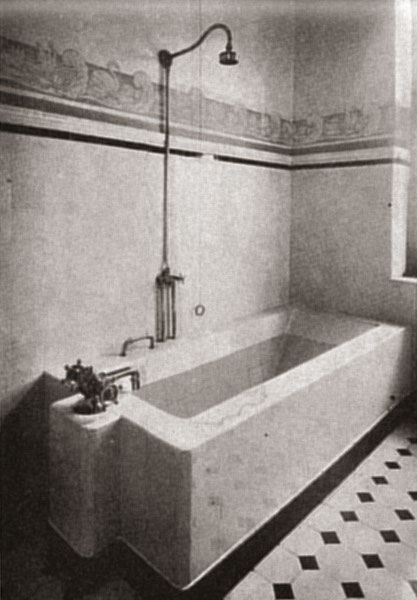
This room in a bathhouse is a little older, but it's very similar to the ones I used to take baths in when I was a girl.
Vati moved the caravan to the end of the commons, hooked up
the stairs, and we children exploded from our tiny home, exploring our new
surroundings. Geese waddled on the grassy meadow, and down a small incline we
found a pond.
“Children, come eat,” I heard Mutti call from the direction
of our caravan.
My stomach was grumbling. I skirted around a goose and
followed my sisters home.
We crowded each other at the kitchen table. Mutti ladled out
potatoes and peas and carrots for everyone. Finally she sat down with a sigh.
She took a few bites.
Franz pokes Josefa, who squealed.
Mutti said, “Quit making all that noise. And look at you! You
children aren’t just noisy, you are filthy.” She turned to Vati. “These
children need a bath. We’re close to Giessen, why don’t we all go take a bath
tomorrow?”
Vati put down his fork. “I do have some time. Okay, we’ll go
first thing in the morning.”
Cool! I remembered the last time I took a bath. That must
have been at the beginning of the traveling season. I couldn’t wait. It would
be fun.
After breakfast the next morning I had forgotten all about
bathing. I swallowed my breakfast roll and drank the rest of my milk in the
cup, ready to go outside where the sun was shining.
“Just a minute,” Mutti called after me. “Carmen, Sonja,
Josefa, stay here. You girls are old enough to get your own stuff for the bath.
I don’t have to do everything for you.”
“What do we need to take?” Josefa asked.
Carmen, as the oldest, knew. “New underwear and socks,
dummy,” she said.
Josefa and I took off for the bedroom, where our clothes
were stashed in shallow drawers under the bed.
“And don’t forget a new dress,” Mutti called after us.
Carmen showed us how to wrap everything into the dress, and we
were ready. Mutti had hers, Vati’s, Franz’s and the baby’s stuff in her large
shopping bag.
Vati must have been glad to go to the bathhouse, too, since
he wasn’t grumbling and had the car already started.
Franz and we three big girls squeezed into the back of the
VW. Mutti stashed the clothes under the hood of the car and sat next to Vati,
Eva in her lap.
At the bathhouse, Vati paid for all of us. We children cost
25 pfennig each, and Mutti and Vati
cost 50 each, which was half a Deutsche Mark, or half of 25 US cents.
The attendant, and rotund woman with gray hair, handed me
and my sisters each a bar of soap and a towel and reminded us not to take too
long. I balanced the towel and soap on top of my dress, the same way Carmen and
Josefa did.
Vati took Franz’s towel, took Franz by the hand, and they
left for the men’s section.
Like little ducklings, we trailed after Mutti. She showed us
three adjacent cabins, one for each girl, and told us she’d be in the one next
to Josefa with Eva.
Mutti told me and Josefa to watch Eva in the hall while she
went into Carmen’s cabin with her and started the bathwater. She did the same for
me and Josefa, then disappeared into her cabin with the baby.
I found myself in a tiny cabin, just large enough for a
bathtub and a wooden seat on the opposite wall. I could lock the door! That was
fun. We had no locking door in the caravan. After I locked and unlocked it a
few times I deposited my clothes and the towel on the bench and put the soap
into the soap holder by the bathtub. By the time I had my clothes off, the tub
was more than half full. I turned off the faucets and sank into the wonderful
warm water. How nice it would be to have warm or hot water running out of the
walls in the caravan. But that wasn’t possible; even I knew that.
In the tub I drew soap letters onto my arms and legs,
splashed with my hands and feet and turned over and over like an otter I had
seen in a book once. I felt like singing but knew it was verboten, forbidden. Also, Mutti didn’t like it when any one sang,
so I didn’t.
Eventually I remembered to wash my always cropped hair. I
dove under the water to rinse off the soap. That was so much fun. When I
finally got out. I thought that I still had soap in my hair, so I carefully
started the water again, the way Mutti had shown me, first the hot and then a
little of the cold until it felt right. I held my head under the faucet and let
the water run through my hair and down my neck.
Someone knocked on the door. I turned off the water. “Hurry
up,” Carmen said, loudly, but not too loud so as not to bother other bathers.
“Mutti is already out.”
I held my head against the door and said, “I’m already done.
I just have to dress.” Hopefully, I wouldn’t be the last one to be out.
With the towel, I rubbed my hair and my body dry and slipped
into my clean clothes. The old ones I rolled into the old dress and unlocked
the door. My sisters and Mutti sat in the waiting room at the end of the
hallway. My heart sank. Mutti would be mad that I was the last one out. But
then I realized Vati and Franz weren’t there yet. Good. She wouldn’t single me
out then.
I ran into the waiting room and plopped onto the bench next
to a scrubbed and damp Josefa. From the men’s section, Vati came out, skin red
and hair wet. Franz trailed after him, also with wet hair.
That night in our caravan, I went to sleep with the sweet smell
of soap and lavender in my nose.
Friday, January 27, 2012
Water

A typical small town well in Germany. I got water from many wells like that.
Oh, how I hated it when Mutti said, “Sonja, take the
canister and get some water!”
She might have run out cooking or mopping the kitchen floor
(which was almost impossible to keep clean with seven people coming and going
all the time.)
I’d grab the hated canister, an old U.S. army metal
contraption Vati had exchanged from an American soldier for some free circus
tickets. He got it when I was a baby; before he lost the circus. It had a small
opening on the top with a chained-on screw-in lid, and it was heavy even
without water. But, living in a caravan, it was an important part of our lives.
We had no running water, and at that time, we also had no way to store a large
amount of water. So, every day or two, one of us children had to get water.
If we were in a small town, I’d go to the town’s well,
located near the center of the town. It had a trough connected to the pump,
which was always full of water, ready for the cows and other livestock to come
home in the evenings and take a drink before going on to their barns. I’d put
the canister onto the grate under the pump, grab the long handle and pump it up
and down for the water to come up. Until I was about twelve, I could not carry
the canister when it was completely full. It held about ten gallons. I filled
it as full as I could carry and dragged it back to the caravan home.
In towns where the well wasn’t close, Vati asked a
neighboring farmer if we could get water from his outside tap.
To save water, Mutti made us wash only our hands and faces in
the evenings. I don’t think I saw a toothbrush until I was ten.
To get us ready for bed, Mutti filled a bowl half-full with
water and put it onto the kitchen table. She grabbed the baby, little Eva, or
later, baby Michael, and wiped her face with a rag reserved for the children. Then
she soaped her hands and rinsed them in the water.
The next-oldest child was next. We used the same water for
the three youngest, and the same face rag for all of us. When it came my turn,
I swiped the rag over my face. Sometimes Mutti inspected our work. “You missed
your mouth,” she might say, or, “wash your ears, too.” But most often she didn’t
even look. The last one, Carmen, poured the used water into the slush bucket by
the door and put away the bowl.
One after the other, we tromped into the back compartment,
the children’s bedroom, took off our clothes and slipped into the cold bed.
Tomorrow I’ll talk more about water in the caravan.
Wednesday, January 25, 2012
Home Again!
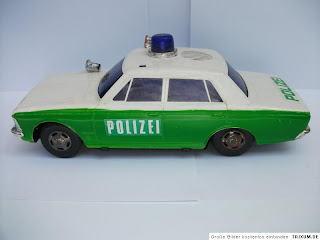
Many German police cars looked like this at that time.
“That’s not ours,” I said. My heart beat faster, and the pastry in my stomach roiled. Maybe Jesus didn’t want me to go home again. Maybe He didn’t love me, after all. I grabbed Josefa’s hand, the only support I had left in this world. Josefa squeezed my hand and started crying again.
“That’s not ours,” I said. My heart beat faster, and the pastry in my stomach roiled. Maybe Jesus didn’t want me to go home again. Maybe He didn’t love me, after all. I grabbed Josefa’s hand, the only support I had left in this world. Josefa squeezed my hand and started crying again.
“Don’t cry,” the policeman said. He didn’t seem too upset. “I know of
another place where your family probably is. Let’s go.”
He started the car and off we went. This time I watched the streets. I
didn’t feel like admiring the stars anymore. What would happen to me if the
policeman didn’t find our caravan home? Maybe I would die, since I was such a
bad girl and couldn’t even take care of my sister. My eyes burned and tears
threatened to come again. Then I remembered my prayer, and how peaceful I felt
when it was over. Jesus would help. I sighed and closed my eyes. “Please, let
us find our home,” I whispered so Josefa couldn’t hear. A sense of safety
surrounded me.
The car went around a dark corner onto a dirt road. At the edge of the
car’s lights, I made out two people running toward us. I thought they looked
like our parents, but for a moment I wasn’t sure. I gripped Josefa’s hand
harder. However, when they came into the light, it was our Vati and Mutti.
“There are my parents,” I yelled. Everything was okay now. I hadn’t hurt
anyone, and the police had even helped me. Mutti would be mad, but that was
okay, as long as I was home again.
The policeman stopped the car and said, “All right! I told you I’d find
your family.”
He stepped from the car and talked to Vati. I opened the door and got
out. Josefa scrambled after me.
Mutti bent and put her hands on Josefa’s shoulders. “Are you all right?
God, I was so worried.”
I stood in front of the car, hands folded over my chest. Mutti let go of
Josefa, turned to me and touched my face. “What happened? Where have you been?”
she said. “We worried out of our minds. Vati and I were just on our way to the
police.”
“We got lost,” I said.
The policeman said good bye and shook our hands. “It was a pleasure to be
able to help you two ladies.”
Josefa giggled.
Mutti gazed at me, frowned and shook her head. “Come on,” she said. She
didn’t seem too mad. We scurried after her and Vati, back to our caravan home.
“We already ate,” Mutti said. “It’s late, but I’ve saved you some food.
Hurry and eat and go to bed.”
“The nice policemen gave us some pastries,” I said. “I’m not hungry.”
“Me neither,” Josefa said.
Finally back in our warm home, we took off our clothes and washed our
faces in the kitchen bowl before we went to bed.
Safely in my bed, I folded my hands and whispered a heartfelt “Thank
you,” to Jesus.
Thursday, January 12, 2012
Winter Quarters

The winter I was nine, we stayed in Wiesbaden for winter quarters, where I would attend third grade more regularly. When we arrived in Wiesbaden, Vati pulled our caravan home through a drizzly, dark afternoon. I sat on the bolted-down bench in front of the kitchen table, hugging the wall and peering out the window in anticipation, wondering what our new winter quarters would look like.
I thought back to my first grade winter
in Atzbach, the only town in Germany that had storks at that time. In the
summers, they lived in a huge nest on top of the school chimney. I had still been
there, attending school, when the storks arrived in the spring. I loved these
great, ungainly birds. Too bad we couldn’t go back to Atzbach. It would have
been so nice to see the storks again.
But last year hadn’t been bad, either.
That was my second grade year, and we spent that winter in Weilmünster. Vati
had exchanged his old BMW motorcycle for a black VW bug with two tiny,
egg-shaped rear windows, and blinkers that came out on the outside of the car,
like little red flags. But the most exciting thing that year was the birth of
our youngest sister Eva.
Now, once again on our way to winter
quarters, the rubber tires of our home rolled along the ruts of the path,
pulled by Vati’s old Deutz tractor. With every jolt, the caravan swayed. A
large open field, fenced in on two sides and the back, seemed to be Vati’s goal
for our caravan. Weeds grew like a small forest along the sides. Close to the
fence on the right snuggled three other caravans, painted a light blue in
contrast to our dark brown ones. One of them seemed a home, recognizable by the
curtains in the windows. Two unfamiliar pack trailers flanked it, probably
holding a carousel and other carnival attractions. I searched the windows of
that caravan home. Maybe the family had children, and I’d finally have a friend
for more than a week. I couldn’t wait to go outside and see.
Vati maneuvered our home around the
other caravan and positioned it next to our pack trailer, which he had towed
there the day before.
The Deutz made one more “chug,” and
stopped. Mutti unwrapped the radio from its blankets on the sofa and placed it
on the shelf over the coffee table. She directed Carmen to unlock the cabinets
in the kitchen. Eva, ten months old, sat in her playpen in a corner of the
living room, watching the commotion. Josefa and I stood by the sliding door
that divided the kitchen from the living room, craning our necks to see what
Mutti was doing.
“Get out of my way,” Carmen said as she
rushed by me and Josefa. Little Franz, bundled in his jacket, pushed through and
went outside, trailing after Vati, who connected our caravan home to the
electricity and made sure everything was settled.
Mutti squeezed around Josefa to get
into the kitchen. “You’re in my way. Why don’t you two go outside for a while,”
she suggested.
I looked at Josefa, who must have felt
as out of place as I did in our cramped home. I had an idea. “Let’s explore the
new place.”
Josefa’s eyes lit up. We went to the
hook by the door, grabbed our coats and struggled into them while we barreled
down the steps which Vati had already connected to the outside of the front door.
Tuesday, January 10, 2012

Monday, January 9, 2012
Uncle Henrik

Uncle Henrik (shown here as a young man working as a hired hand for the Nazi owner) was the lion tamer in the Circus Francesco. After the war in Poland, he became somewhat of a celebrity when he was the first person who successfully bred a lion with a tiger. The resulting cub is called a liger.
A year after I was supposed to go to Poland, our family received their second visit from a family member.
***
A year after I was supposed to go to Poland, our family received their second visit from a family member.
It was around Christmastime, and I had settled into going to
the same school for the winter. One day I came home and found a stranger sitting
at the kitchen table with Vati. In front of them stood a half-empty vodka bottle
and two shot glasses. Vati was talking to the stranger in what I thought was
Polish.
Mutti came from the livin groom and said, “Henrik, this is
our second, Sonja.” She turned to me. “This is your uncle Henrik.”
I remembered that Vati had talked about his brother coming
to visit from Poland, but had forgotten all about it.
I stretched out my hand and the stranger took it. “Hallo
Sonja,” he said gravely.
Carmen and Josefa burst in after me, trailed by Franz. Mutti
shooed me into the
living room and introduced my sisters to Uncle Henrik.
“And this is our son, Franz. He’s named after your father.”
Uncle Henrik rose and hugged Franz, who squirmed in the
embrace of this stranger. When Henrik was about to sit down again, Mutti
touched his arm. “Why don’t you and Colya go into the living room. I have to
start supper now.”
Vati rose, and as he went through the open sliding doors into
the living room, he stumbled against the edge of the door and mumbled something
in polish. Uncle Henrik grabbed the bottle and the two glasses and followed
him.
Mutti came after him. “Carmen, Sonja, Josefa, come here. You
have homework to do. Eva, you come too.”
Uncle Henrik said something in Polish to Vati. “Franz, join
us,” Vati called. “You’re the only man among all these women. You drink with us.”
Nine-year-old Franz stood in the doorway, not moving. Mutti
took his arm and looked around him into the living room. “You will not give
this child any vodka, Colya. You and Henrik can drink all you want, but Franz
will stay here. He is a child, understand?”
Vati looked at Henrik who took another sip from his glass.
“You women. Always meddling,” he mumbled and then slipped back into Polish.
Soon he had forgotten all about it, and laughed and talked with Henrik while we
sisters, and Franz, too, finished our homework, with Eva playing on the floor.
Mutti finished a large plate of open-faced sandwiched for us
children and carried a smaller plate into the living room. We ate, listening to
Vati and Uncle Henrik talk, hoping in vain to understand something.
After supper, Mutti got Eva ready for bed and shooed us off
to sleep long before our usual bedtime. I heard Vati, Mutti and Uncle Henrik
talk and laugh until I drifted off to sleep.
Uncle Henrik stayed a week. He was not talking much to us
children, I assumed because he didn’t understand much German, but he was always
friendly and sometimes a little too friendly, trying to hug and kiss us. Our
parents never hugged or kissed us, so it seemed weird to me that a strange men,
eve if he was an uncle, would do that. But somewhere deep inside I loved it!
When Uncle
Henry left, he gave Mutti several kielbasa hard sausages and other Polish food.
I will never forget the wonderful taste of kielbasa in lentil soup, kielbasa
sliced on a piece of bread, and kielbasa with sauerkraut.
I never saw Uncle Henry again after he left.
Saturday, January 7, 2012
A Visit to Poland
I was eleven that year. One evening in November, after we
settled down in winter quarters, I overheard Mutti and Vati talking.
Josefa and I were sitting at the kitchen table, finishing
some homework, when Vati’s deep voice resonated through the small caravan home.
“My sister would be delighted to have her namesake come and visit her.”
Josefa looked up from her math book and frowned at me. “What
do they mean?” she mouthed.
I shrugged, but a knot formed in my stomach. Did my parents
want to send me away? Maybe forever? I didn’t know how to live anywhere else
but here in my family. Maybe Vati would go with me. Then it wouldn’t be so
scary.
The next morning Mutti handed me my sandwich for lunch
break. “Come right home from school today. We have to get your visa pictures
made.”
I took the sandwich bag and stuffed it into my satchel. “Are
you really going to send me to Poland?”
“It will be a great opportunity for you.” She opened the
door. “Now go on or you’ll be late for school.”
“Will Vati or you go with me?”
“Don’t worry about that. Off with you to school.” She pointed
to the outside.
I decided now wasn’t the time to discuss this and left. But
the thoughts whirled around in my head. The way Mutti had answered my question
indicated that I would go alone. I didn’t want to go to Poland alone. I didn’t
know anybody in Poland. Why couldn’t I stay here, in our caravan, with my
brothers and sisters? But if I’d say anything Mutti wouldn’t listen to me.
She’d just tell me to shut up.
That day, in school, I tried to imagine what Poland would be
like. All I could think of was a cold, rainy and dark place with lots of
cobblestones and no trees.
I made myself hurry home, even though I would rather have
dawdled. Mutti was waiting with her coat on and purse in her hand. “There you
are. Let’s go.”
I dropped my satchel onto the kitchen bench and hurried
after her, wondering what it would be like to have a picture taken.
The photographer took me to a small, dark room. He had me
sit on a hard stool and told me not to smile. A flash made me squint, and then it
was all over.
The photographer escorted us out. “I’ll have the photos
ready in two weeks. It’s been a pleasure.”
Nothing much happened the next few days. Vati and Mutti
didn’t talk about Poland anymore. I was relieved. Maybe they had forgotten.
One day, when I came home, Mutti said. “The photos for your
visa are here.” She showed me a set of four black and white pictures. They
showed my face and my too short cropped hair. I thought I looked ugly. Maybe
Aunt Sonja wouldn’t like me when I arrived in Poland and would send me back
again.
Vati sat on the living room sofa, writing in some papers.
“My sister will be so glad to have a young person around,” he said. “I’ll mail
the papers as soon as I’m done here. Then all we have to do is wait.”
I hoped getting the visa would take a really long time.
Maybe it would take the rest of the winter, and by spring we’d be traveling
again. Those papers might never reach us, and I’d stay home.
One day in February I came home and heard my parent arguing
before I opened the door to the caravan home. I stopped on the steps and
listened.
“I tell you, if we send her, we’ll never see her again,”
Mutti’s strident voice came through the door.
Vati’s voice, quieter and lower, answered, “I promised my
sister we’d send her. She’ll make sure our child will come back.”
“What can she do when the government refuses to let Sonja return?
A month ago I wouldn’t have worried, but now…” Mutti’s words trailed off.
“Maybe you’re right. We could wait and see what happens. If
the laws lighten up again, we can always send her later.”
“That’s an idea. I’m sure your sister will understand.”
Mutti sounded relieved. “Maybe we’ll send her next winter.”
My heart grew lighter. At least for now I was safe. I
decided that now was the moment to interrupt and charged into the caravan home.
My parents never said another word to me about it, and they
never sent me to Poland.
Wednesday, January 4, 2012
Brigitte
Brigitte, Mutti’s sister was nine years younger than Mutti.
When I was very small, right after the war, Brigitte once came to live with us
in our tiny caravan. By then Mutti had Carmen, Josefa, and me, and my little
brother was a newborn. Brigitte was supposed to help out with us children. But
it didn’t last long before both sisters lost their patience with each other and
Brigitte left again.
She rarely wrote after that and never visited again until I
was a teenager and we had left the carnival circuit. Mutti had separated from
Vati and lived with us girls and baby Michael in an apartment.
One day, a knock came at the door. Eva, my little sister,
opened the door and a strange woman with light brown hair and blue eyes, and
obviously pregnant, asked for our Mutti. Mutti called her Brigitte and pulled
her into the apartment.
Brigitte had nowhere to go, so she lived in my older sister’s
room for a few weeks, while Mutti and she tried to find her a job and a place
of her own. Eventually Brigitte found work at the hospital in Wetzlar, a few
miles away, and moved out. She never contacted my mother again, and we still
don’t know what happened to her. Mutti is 91 now. When I visited her last, I
asked about her sister. Mutti didn’t know whether she was still alive or where
she lived. I don’t think either sister cared too much for the other.
A few years earlier, when I was twelve, we had another
family member visiting. I’ll talk about that soon. Now I’m getting
ready to take out my own little surprise visitor, Liesel, and her sisters!
Thursday, December 29, 2011
Chicken, Potatoes, and Raisins!
Oh, the joys of eating chicken! Chicken Cordon Bleu with
melty sweet Swiss cheese and crisp crumbs on the outside is one of my favorite
chicken dishes. Chicken in yellow gravy, made from a can of creamy chicken soup
and poured over potatoes can still make my mouth salivate.
That day so long ago, we ate chicken and self-picked
dandelion greens with young nettles, and it seemed every bit as delicious to
the little girl I was, as an expertly prepared Chicken Cordon Bleu would taste
today.
After we ate, Mutti saved the rest of the chicken.
The next day, she cut it into small pieces and heated them in a yellow gravy.
We had boiled potatoes with it. What a delight!
We had potatoes every day. They were cheap and grew
well in Germany after the war. I never got tired of them, and I still love
them.
That evening, supper consisted of raisin bread with margarine and
an apple. Carmen said, “Yuck! I hate slimy raisins,” and picked them out.
“Don’t be so dumb,” Mutti said. “Raisins
are good for you.”
But Carmen pushed her little pile of raisins away.
Josefa watched with wide eyes. “Yucky,” she said,
and picked out her raisins, too.
Mutti said, “Little brats.” She picked up Carmen’s
raisins and ate one. “Oh, well. More for the rest of us.”
I, too, poked a raisin out of my slice of bread and
tried it. Carmen was right. They were slimy and gushy and icky. But I wanted to
make Mutti happy. I swallowed it.
Mutti smiled. “At least Sonja eats them,” she said.
“She’s a good eater.”
Pride swelled my breast. I smiled at my sisters
across the table.
Vait took a swallow from his coffee cup. “She eats
so much, but never gains weight. Maybe she’s sick.”
I wasn’t worried about being sick. Mutti was pleased
with me, and Vati was thinking about me. I resolved to always be a good eater,
so Mutti would approve.
Today I have learned to love raisins, especially in
hot oatmeal. And I do have to rein in my appetite so I can stay healthy!
Tuesday, December 27, 2011
Greens
One sunny autumn morning, when I was maybe four or
five, Mutti turned to Carmen and said, “Watch Franz. I’ll have to find
something green for lunch.”
She called Josefa and me, put on her gloves, even though it was warm outside, grabbed her shopping basket, and left. We hurried after her in the morning sunlight.
Mutti strode along the street of the little village we held our carnival in that week. We passed a big building that may have been the city hall. Long slats of wood were all over it, and they almost hid the big burnt hole in the upper story. People climbed all over the wood, working on the broken bricks.
She called Josefa and me, put on her gloves, even though it was warm outside, grabbed her shopping basket, and left. We hurried after her in the morning sunlight.
Mutti strode along the street of the little village we held our carnival in that week. We passed a big building that may have been the city hall. Long slats of wood were all over it, and they almost hid the big burnt hole in the upper story. People climbed all over the wood, working on the broken bricks.
When the sidewalk ended, Mutti turned into a path
marked with grassy ruts. Josefa and I hurried to keep up with her. We tried not
to stumble on the uneven ground. The damp grasses left cold streaks on my bare
legs.
We reached a small pond, and Mutti stopped. Stinging
nettles grew in profusion by the pond, their dark green fleshy leaves crowding
out other grasses. Mutti checked her gloves and broke off the smaller nettles,
piling them into the basket. Josefa was reaching out to copy Mutti, but Mutti
slapped her hand away.
“Don’t do that,” she said. “They’ll sting you.”
“Yeah,” I said. “You don’t know anything.”
Josefa kicked my leg. I screamed and hit her. She
started crying.
Mutti ignored us.
I ran from my sister, being careful not to touch the
nettles. Josefa quit crying, sat in the grass, and played with a dandelion.
When the basket was almost full, Mutti turned toward
the meadow on the other side of the path. She picked the dandelion leaves and
piled them on top of the nettles. Some of the blooms had turned a gossamer gray
and Mutti left them alone. When I picked a gray one and blew on it, the gray
dissolved into many tiny parachutes, which floated softly in the breeze.
Josefa and I ran around the meadow, picking
dandelions and blowing them, until Mutti yelled at us. We trudged back after her
past the bombed out city hall to the grassy commons, where Vati had already put
up the back and sides of the shooting gallery in front of our caravan.
Vati stopped working, picked something white from
the ground next to the half-erected shooting gallery, and followed us to the
caravan home. He held up a dead chicken, his broad hands grasping it firmly by
the feet. Its head dangled from under its white, feathered body, wings
half-spread. The eyes were closed and its beak stood open. I thought the
chicken looked sad.
“I exchanged this for free tickets,” Vati said and
smiled.
Mutti put down her basket and clapped her hands.
“We’ll have a feast today,” she said and took the
chicken. She shooed Carmen and Franz from the caravan, but left the door open.
Franz sat down by the steps and played in the dirt. Josefa and I watched Mutti.
Mutti put the chicken in the wash bowl. Its head dangled over the rim and she tucked that into the bowl too. The feet were sticking straight up. After she heated water on the coal stove she took the chicken outside and poured the boiling water over it. Then she left and let it sit on the caravan steps for a while.
Mutti put the chicken in the wash bowl. Its head dangled over the rim and she tucked that into the bowl too. The feet were sticking straight up. After she heated water on the coal stove she took the chicken outside and poured the boiling water over it. Then she left and let it sit on the caravan steps for a while.
Josefa and I turned to play with Franz who drove an
imaginary car through the dirt, making car noises.
When I looked up again, Mutti sat on the steps,
plucking the feathers off the chicken. They fell in an untidy heap next to the
caravan home’s wheels. When she was done, she cut the belly of the chicken open
and dug out the insides.
I watched, eyes and mouths open.
Josefa joined me. “Yuck,” she said.
Mutti pulled out the intestines. “Most of this isn’t
good to eat. But the rest will taste great.” She looked at Josefa. “If you
don’t want it, we’ll eat it for you.”
“I want it, I want it,” Josefa said, but she sounded
doubtful.
Mutti rose and took the chicken inside.
For lunch we had potatoes with green stuff, made
from the greens we and Mutti had picked that morning, and parts of the chicken.
Carmen and Josefa each got a foot. Mutti showed them how to strip the scaly skin off the foot and lower leg and eat the meaty gristle from between the bones. I got the head. I cracked it open and ate the brains out of it. It was delicious, much better than the greens we helped Mutti pick.
Carmen and Josefa each got a foot. Mutti showed them how to strip the scaly skin off the foot and lower leg and eat the meaty gristle from between the bones. I got the head. I cracked it open and ate the brains out of it. It was delicious, much better than the greens we helped Mutti pick.
***
Many years later, in my spacious kitchen in America,
I remind Mutti of the chicken head. “I couldn’t eat that now. But then it
tasted delicious.”
“I remember,” Mutti says. “We did what we had to. My
children never went hungry.” She sighs and helps me finish washing the dishes.
Saturday, December 24, 2011
Spinach Part Two
Margot sat in front of the mess on her table, not moving. If she’d try
again, she’d throw it up again. But what else could she do? Eventually she took
the spoon again, scooped up a fresh, smaller part of the mess and swallowed it
quickly. Her stomach heaved, but she took a deep breath and it stayed down.
Mutti glanced up from her paper. “There you go. Now eat the rest and
don’t be so stubborn.”
Margot didn’t dare to eat another bite. The spinach in her stomach felt
as if it wanted to crawl up her throat. There must be something wrong with her.
Other people ate spinach, why couldn’t she? She hung her head.
Brigitte’s cries from the hallway faded. She must have fallen asleep
again.
Margot stared at the spinach for an eternity. Finally the front door
slammed.
Mutti rose. “Is that you, Max?”
Max came in. A raindrop glistened on his nose. “Hi Elfriede, hi Margot.”
He put his lunchbox onto the table and kissed Mutti on the cheek. “What’s going
on? It’s after four. What’s Margot doing still eating?”
Mutti’s forehead creased. She glanced at Margot, eyes hard and cold like
ice. “You know how she is. She’s determined not to eat her spinach, no matter
what. And I’m determined that this time, for once, she will.”
“But I don’t like it,” Margot wailed.
Max came closer, staring at Margot’s plate. He pointed. “Is that
throw-up?”
Margot shrunk tighter into her chair. In spite of her efforts, hot tears
squeezed from her eyes. “I’m sorry.
I couldn’t help it. It just came up again. I tried to eat it. I really
tried.”
Without another word, Max turned, took Mutti by the elbow, and pulled her
into the hallway. The kitchen door snapped shut.
Margot swallowed. Maybe this was her chance to rinse the mess into the
sink. But if Mutti would catch her again, she’d beat her with the wooden spoon,
besides making her eat it. She couldn’t risk it. She stared at her plate
without seeing it. Her bottom was hurting from sitting in the hard chair for so
long.
The door to the hallway opened. Max came in.
Faintly, Margot heard Mutti in Brigitte’s room, talking to her in that
soothing, sing-song voice she used for the baby.
Max marched up to her, took her by the elbow, and pulled her out of the
chair. “Go into your room and don’t come out again for the rest of the day.
I’ll bring you a sandwich in a while.”
Margot turned to him. “And I don’t have to eat that spinach anymore?”
“No, you don’t. Your mother will be fine in the morning. Just stay out
of her sight today.”
Margot threw her arms around his waist. “Thank you! Thanks so much.”
Max disengaged himself from her embrace. “Hurry up now. I’ll see you later.”
Margot tiptoed past Brigitte’s open bedroom door and gently shut the
door to her room behind herself. She threw herself on the bed and buried her
head into her pillow. She might be a bad girl because she couldn’t please her
mother, but if she ever had children, she would never make them eat stuff they
didn’t like, especially not spinach.
***
And she never did.
Subscribe to:
Posts (Atom)