Showing posts with label caravan. Show all posts

Sunday, February 26, 2012

The Scooter 2nd Part


Vati was reaching behind the picture with one hand while holding it in place against the carousel with the other.

In my excitement about maybe getting a new scooter for me and my siblings, I didn’t notice his irritated cussing at the screw. “Vati,” I called, “can we get a scooter for ten carousel tickets?”

Vati didn’t even turn to look at me. “No. Leave me alone. Now I dropped that &*&% screw.”

I stepped closer. If he’d just listen he would understand that this was important.

Before I could open my mouth again, he said, “Get out of here, now.”

I knew that tone of voice. If I’d persist now, he would push me, or worse, hit me, so I trudged back to the girls and Josefa, who was bent, inspecting the younger girl’s scooter.

I walked up to the older girl who looked at me expectantly. “My Vati won’t give me any tickets.”

“I guess I’d be happy with seven tickets, too,” she said.

“I can’t talk to him right now. He’s mad. Could you come back tomorrow?”

Josefa straightened and almost dropped the scooter. “Yes. Tomorrow. We’ll get you the tickets then.”

“And bring the scooter. Maybe if he sees it, he’ll give us the tickets.”

“Sounds good. I’ll bring it later.”

“Please?” Josefa chimed in. She looked at the girl with her bright, brown eyes and made her really cute face.

The big girl smiled at her.

The littler girl reached out her scooter. “Here. You can take a ride.”

I wandered off. Too bad I couldn’t make a cute face like Josefa could.

Mutti called me into the caravan home and gave me the new potato peeler we’d bought a little while before. “Here. Peel me six potatoes. It should go easy with this.”

Listlessly, I hacked at the potatoes, all the while thinking about that scooter. How we could whiz through each new town with that! All the other kids would be so jealous.

Josefa drifted in, and soon Mutti called out the caravan door, “Vati, Franz, essen kommen, come and eat!”

We finished our supper. When Vati was finished, he pushed away his plate and leaned back.


He grinned at me and Carmen and patted Franz on his head. “I got something for you children.”

Franz looked up. “What is it?”

The way I knew Vati, it probably was something that required us to help Mutti in the caravan home. But his next words confused me.

Vati focused on me. “It will keep you out from under your mother’s feet, I hope. Come on out and see.”

I rose and followed after Franz and Josefa.

Outside, leaning against the caravan steps, stood a brown scooter with red handlebars.

“Oh,” Josefa said, for once speechless.

Franz touched the handlebars. “Can I learn how to ride it, too?”

Vati patted his back. “Sure you can. But first, let your sisters try it out.” He turned to me. “Is that what you wanted earlier when you bothered me?”

I nodded. “Thank you so much,” I managed to say.

Carmen added, “We’ll take good care of it. I promise.”

And that was how we got our scooter. When we were traveling, it rode in the pack trailer, where Vati stored the carousel and the other attractions.

Franz soon learned to ride it too, and not long after, raced it down a steep declining street. He couldn’t brake in time and hit the wall at the end of the street. He had to have six stitches in his forehead.

Saturday, February 25, 2012

The Scooter

As I watch my grandchildren play in the unseasonably warm weather outside, I remember my own childhood at the carnival. Here's a little story about a toy I and my sisters wanted really badly.

We were running the carnival in another small town in central Hessia. Carmen, Josefa, and I trundled home from school, leather satchels on our backs. One of the girls in my class whizzed by on one of the wooden scooters that were so popular that year. These scooters looked a lot like the metal toy scooters nowadays, except they were bigger and had only one wheel on the front and on the back. As she sped by us, the girl stood on the board between the wheels, braids flying.


“I wish we had a scooter, too,” Josefa said.

I sighed. Mutti and Vati couldn’t afford many toys, and we wouldn’t have any room in our caravan home for it, anyway.

We arrived home, had lunch, and worked on our bit of homework until Mutti said, “Go on out girls. The sun is shining.”

I grabbed my jacket and followed my sisters outside, squinting into the sun. When my eyes got used to the bright light the first thing I saw was the same girl, standing next to her scooter and watching Vati put up the carousel. Next to her stood a much older girl, freckles all over her face, looking just like the girl with the scooter.

Her scooter looked just like that!


I approached them, eyeballing the scooter. “Nice scooter you have,” I ventured. Josefa came up from behind me and nodded.

The younger girl smiled, and the older one stared at us. I got brave. “Can I go for a ride on it?”

The younger girl didn’t let go of the handle. “Don’t you have one?”

Josefa and I shook our heads in unison.

“Maybe we’ll get one soon,” Josefa said.

The younger girl pushed the scooter toward me, but the older girl grabbed her arm, still looking at me. “I could sell you mine. I’m too old for such a silly toy.”

Josefa frowned. “We have no money. Maybe your sister could let us ride hers for a while?”

I glanced at Vati, who was putting up another picture on the outside frame of the merry-go-round. “We could give you some carnival tickets. If that’s okay, I mean.”

The tall girl nodded. “Sounds good. You can have it for ten tickets.”

“Let me ask my Vati,” I said and ran off.

More about the scooter tomorrow!

Friday, February 10, 2012

Vati's Parents

This is the only picture of grandfather Franz Wawrzyniak and grandmother Wawrzyniak I've ever seen. Can you make out the back of the circus tent behind them?


The little I know about my Polish grandparents came from Mutti. Vati almost never talked about them, and seldom talked about his brothers and sister.

I know that my grandfather’s name was Franz, since my brother was named after him. Franz Wawrzyniak, or Francesco (which was his artist name) owned Circus Francesco, one of the largest circuses in Poland before the war. The family traveled along the Polish-Russian border a lot, and during one of their tours in Russia my father was born. So technically Vati was a Russian, not a Pole.

I learned about that when I got ready to get married to an U.S. soldier. My fiancĂ©, Gary, had a top security clearance. When his superiors discovered that the father of his bride was born in Russia, they advised him to just live with me and marry me after he’d left the service.
For both of us this was out of the question, however, so Gary took a demotion in his clearance and a less sensitive job in the Army, and we got married. Eventually, they returned him to his highly classified job, since he was the best they had for it!

Back to my Polish grandparents. I’m not sure if it’s true, but Mutti told me that Vati had two older brothers who stayed in Russia when the circus returned to Poland before the war. In any case, the Nazi army invaded and conquered Poland. Circus Francesco kept traveling in Poland, but within a very short time the Nazis requisitioned the circus, made a Nazi party member the owner, and forced the Wawrzyniak family to work as hired artists in their own circus. The Nazi owner then gave the circus to a small German circus family as a wedding present, and now the family traveled in Germany. My grandfather died shortly after he was forced to work in his own circus in Germany. Mutti told me it was from grief to see his life’s work stolen away.

This happened before Vati and Mutti met. After the war, the Wawrzyniak family regained their circus, and, before I was born, they returned to their beloved Poland. Mutti refused to go to another country where a totalitarian government ruled, so Vati stayed with her in Germany. His mother must have died around that time, since when I was born she had already passed away.

My father’s two brothers and one sister stayed in Poland. We children met Uncle Henrik only once, and never met Aunt Sonja or Uncle Josef.

The only family I knew of lived in our little caravan home.

Next time, I’ll talk more about Mutti’s parents and why we never met them, either.

Wednesday, February 8, 2012

The Joy of Having Grandparents

Grandpa and Granddaugther

No child can ever have enough grandparents! Whether grandma is Mom’s or Dad’s mother, grandpa’s second wife and joined the family after the grandkids were already born, or whether she is a great-grandma, or the mother of Daddy’s second wife, it doesn’t matter at all to a child!

I think I’ve been all of them, except for a physical grandmother, since none of the children I gave birth to have babies yet. And yet I have enjoyed every one of my grandkids, none of them step-grandkids in my way of thinking.

What matters to a child are these: Cookies on the table when visiting grandma and grandpa, the toys the grandparents have stashed away for the kids to play with when they visit, the rides they take them on, and the games they play.

When the grandchildren get a little older, grandparents become even more important. When mother does nothing but complain at you, when father orders you around, when you have no one to talk to who understands, there are always the grandparents. They might be old, but they know how to listen. They might take you to a dinner and a show. And they always patiently wait until you’re ready to talk. They don’t complain and don’t judge, and sometimes they say something that helps you a lot.

What blessings grandparents can be!

Below is a link to A Cup of Comfort for Grandparents, where you can read a story about my boy Daniel and his grandparents.


When I was small, living in the caravan home, I had grandparents too. But I couldn’t envision them, at all. More about my grandparents next time.

Monday, February 6, 2012

More About Mutti


 Mutti in 1998

Provo, Utah, 1998

My last three children, now teenagers, my husband, and I picked Mutti, now 78 years young, up from the airport. Her coal black hair was streaked with rusty red, the gray covered up. Her black eyes, now imbedded in wrinkles, were as alert and expressive as ever. She was excited to be in America. And for me, it was time to finally keep the promise I made to myself so long ago, to have her tell me her story. 
A few days into the visit, I asked her if it would be okay if I interviewed her about her youth.

“There are still some things that are hard to talk about,” she said, “but it’s time to tell the story.


“I’m going to write a book about your life,” I told her.


Mutti laughed. “We’ll see. But even if you don’t, the story needs to be told.”


The next day, armed with three empty 90-minute tapes and a tape recorder, I entered the kitchen where Mother sat at the table drinking coffee.


“Are you ready?”


Mutti put down her coffee and nodded. I showed her how the tape recorder worked and started her talking with a question. “What was your father like?”


And she told me. The story spilled out and I taped for hours, filling all three tapes. I listened, entranced, to a life undermined by the Nazis, the life of
a scared young woman in Hitler’s Germany, who wanted nothing but a little happiness in her life. This is a story that should never be forgotten.

As I listened, I started to understand why Mutti had been so distant when I was a child, but as a child, I saw the lack of love in our lives as normal. 


Later, I transcribed my mother’s story, and then used it as an outline for a novel. The book is finished, but not yet sold to a publisher. Hopefully, that will happen in the near future, too.

Read the first chapter here: Walk on a Wire.

Saturday, February 4, 2012

Deciding my Future

 Thank you Alexandrea Zenne, for this beautiful picture of a tightrope walker! That's how I imagined a high wire walker to look when I was in fifth grade!


Germany, 1958 

My paper on Icarus and Daedalus had received an “A” in the fifth grade class I attended that week. In spite of my haphazard education and in my childish enthusiasm, I decided I would be a writer one day. And the first thing I would write about would be Mutti’s life. I ran home, full of excitement.

Mutti stood in the kitchen of our caravan home, stirring soup in a pot and listening to soft music coming from the radio in the living room.

Over the sound of the music I heard my siblings outside, helping Vati put up the merry-go-round. Good. I had Mutti to myself for a few minutes, and she seemed in a good mood. Now was the perfect time to do some research for my future writing career. 

I leaned against the counter opposite the stove. “Why did you join the circus Mutti? And how did you find it? What did you do in the circus?” I half expected her to brush me off, but she didn’t. 

A far-away look settled in her eyes, and she sighed. “That was a long time ago, child. I needed to get out of Berlin, and the circus seemed the perfect solution. It was a way out of all my trouble.” She stopped, turned the propane fire under the pot to low, and pulled a chair from the kitchen table.

I slipped into the converted bus seat Vati had screwed to the floor between the table and the wall. “Did you need to leave Berlin because of Hitler?”

“Yes. The Nazis were everywhere. I was lucky to find the circus.”

“Did you meet Vati there?” 

“Yes.” 

Enveloped by the enticing aroma of oxtail soup, we sat at the kitchen table. Mutti told me about how she met my father. I listened, as quiet as the circus audience when the tightrope walker performs. Mutti rarely talked about her life, but as long as I could remember, I knew she was half-Jewish and hid from Hitler during the war. I watched her, still so beautiful, talk about a past that was surely more bitter than sweet, and knew I would one day write the story of her life. 

And I have!

Tune in for more soon!

Thursday, February 2, 2012

About Mutti


At 91, Mutti like to talk about Berlin and how she grew up. She loves talking about the Busch fashion store, where she apprenticed at fourteen, and where she stayed until she was eighteen. It seems those four years were the highlight of her life.

The original owners of Busch’s fashion store were Jews. When the Nazis deported them to a labor camp after Kristallnacht, (the Night of Broken Glass) the new Nazi owner fired her. Mutti loves talking about Busch’s, but she doesn’t talk too much about what happened to her after she had to leave there.

Once, when she was visiting me in Provo, where I live, we sat down, I asked her guiding questions, and she told me what happened. I taped our conversation, and using her unusual life as an outline, wrote a novel about her efforts to stay ahead of the Nazis during this terrifying time.

My memoir, Carnival Girl, will be published in a few months, and I hope Walk on a Wire, the novel based on Mutti’s life, will be next!

I’ll write more about Mutti tomorrow.

Tuesday, January 31, 2012

Fahrtenschwimmer (Swimming, Part Two)


                                              My Fahrtenschwimmer decal looked a lot like this one

When I was a teenager, Mutti left the Carnival with us girls and little Michael. We stayed in the caravan home in Wetzlar for about one year, then moved into an apartment in a tiny town close to Wetzlar. I rode my bicycle to Wetzlar to work every morning.

I was seventeen by that time, but because I had left school at fourteen, and because of our constant traveling I had never made any friends.

A seventeen-year-old without friends is a rare thing! Something had to take the place of friends, and I did find two things that delighted me to no end. I had converted to the LDS church two years earlier, and in our tiny branch in Wetzlar I made a friend, a girl with whom I’m still in contact today. However, she lived in Giessen, about twelve miles from Wetzlar, and even further away from the tiny town I lived in, so we saw each other only occasionally, and when we took the train to visit each other.

The other thing that I delighted in doing might have found me friends, but because of my background, which taught me to be careful and not make friends because I would just lose them again, and because of a natural shyness of strangers, it never did.

But I did have fun! I went to the indoor pool in Wetzlar every week or so, to swim, teach myself to dive, jump off the board, and in general delight in playing in the water. Most of the kids in the pool were younger and I kept to myself for the above mentioned reasons. I learned to swim on my back and under water, but I never could teach myself the crawl, which is so commonly taught here in the States.

One day, I was playing along the rim of the pool when the life saver on duty, and older man, at least twenty-five, bent down and talked to me. “I see you here a lot. Would you be interested in getting your Fahrtenschwimmer?”

I had heard of Fahrtenschwimmer before, but wasn’t sure if I could do it. “What exactly would I have to do to get it?”

“You have to be able to swim for fifteen minutes without touching the bottom or the sides and dive for ten meters and bring up one of these blocks.” He held up a black rubber block with a handle. “They’re only five pounds. Also, you have to dive off the high board and swim on your back without using your arms.”

“I don’t know.” I frowned at the man. “It sounds hard.”

“It isn’t. I’ve seen you do all of that just for fun. If you pass, you’ll get your certification. You could go on from there, take another test, and even become a lifesaver, if you want.”

That sounded great to me. “How much does it cost?”

“It’s only five Marks. I have regular times when I administer the test. You’ll be certified right afterward. So how about it?”

“Yes. I want to do it.”

“Come with me to my office, and we’ll set you up.”
Two weeks later, on a Saturday when I didn’t have to work, I took my Fahrtenschwimmer test and passed it. I received a little decal and a blue booklet certifying that I passed and could go on from there.

At home, I showed it to Mutti, but she was busy with Michael and just glanced at it. I put it away, intending to take the next test, which included forty-five minutes of swimming and some diving. But things got in the way, and I never went back for it.

However, I still delight in swimming and water play.

Saturday, January 28, 2012

Bath Time!


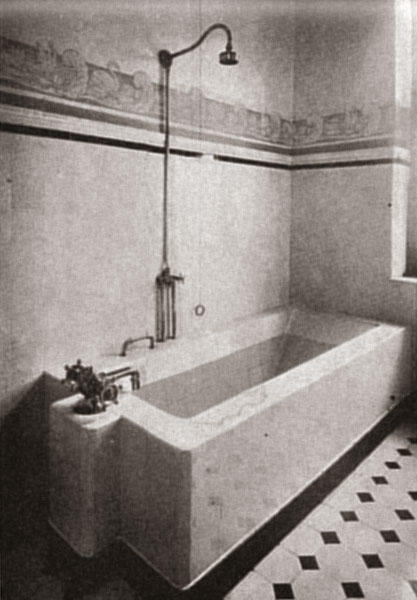
 This room in a bathhouse is a little older, but it's very similar to the ones I used to take baths in when I was a girl.

 Vati moved the caravan to the end of the commons, hooked up the stairs, and we children exploded from our tiny home, exploring our new surroundings. Geese waddled on the grassy meadow, and down a small incline we found a pond.

“Children, come eat,” I heard Mutti call from the direction of our caravan.

My stomach was grumbling. I skirted around a goose and followed my sisters home.

We crowded each other at the kitchen table. Mutti ladled out potatoes and peas and carrots for everyone. Finally she sat down with a sigh. She took a few bites.

Franz pokes Josefa, who squealed.

Mutti said, “Quit making all that noise. And look at you! You children aren’t just noisy, you are filthy.” She turned to Vati. “These children need a bath. We’re close to Giessen, why don’t we all go take a bath tomorrow?”

Vati put down his fork. “I do have some time. Okay, we’ll go first thing in the morning.”

Cool! I remembered the last time I took a bath. That must have been at the beginning of the traveling season. I couldn’t wait. It would be fun.

After breakfast the next morning I had forgotten all about bathing. I swallowed my breakfast roll and drank the rest of my milk in the cup, ready to go outside where the sun was shining.

“Just a minute,” Mutti called after me. “Carmen, Sonja, Josefa, stay here. You girls are old enough to get your own stuff for the bath. I don’t have to do everything for you.”

“What do we need to take?” Josefa asked.

Carmen, as the oldest, knew. “New underwear and socks, dummy,” she said.

Josefa and I took off for the bedroom, where our clothes were stashed in shallow drawers under the bed.

“And don’t forget a new dress,” Mutti called after us.

Carmen showed us how to wrap everything into the dress, and we were ready. Mutti had hers, Vati’s, Franz’s and the baby’s stuff in her large shopping bag.

Vati must have been glad to go to the bathhouse, too, since he wasn’t grumbling and had the car already started.

Franz and we three big girls squeezed into the back of the VW. Mutti stashed the clothes under the hood of the car and sat next to Vati, Eva in her lap.

At the bathhouse, Vati paid for all of us. We children cost 25 pfennig each, and Mutti and Vati cost 50 each, which was half a Deutsche Mark, or half of 25 US cents.

The attendant, and rotund woman with gray hair, handed me and my sisters each a bar of soap and a towel and reminded us not to take too long. I balanced the towel and soap on top of my dress, the same way Carmen and Josefa did.

Vati took Franz’s towel, took Franz by the hand, and they left for the men’s section.

Like little ducklings, we trailed after Mutti. She showed us three adjacent cabins, one for each girl, and told us she’d be in the one next to Josefa with Eva.

Mutti told me and Josefa to watch Eva in the hall while she went into Carmen’s cabin with her and started the bathwater. She did the same for me and Josefa, then disappeared into her cabin with the baby.

I found myself in a tiny cabin, just large enough for a bathtub and a wooden seat on the opposite wall. I could lock the door! That was fun. We had no locking door in the caravan. After I locked and unlocked it a few times I deposited my clothes and the towel on the bench and put the soap into the soap holder by the bathtub. By the time I had my clothes off, the tub was more than half full. I turned off the faucets and sank into the wonderful warm water. How nice it would be to have warm or hot water running out of the walls in the caravan. But that wasn’t possible; even I knew that.

In the tub I drew soap letters onto my arms and legs, splashed with my hands and feet and turned over and over like an otter I had seen in a book once. I felt like singing but knew it was verboten, forbidden. Also, Mutti didn’t like it when any one sang, so I didn’t.

Eventually I remembered to wash my always cropped hair. I dove under the water to rinse off the soap. That was so much fun. When I finally got out. I thought that I still had soap in my hair, so I carefully started the water again, the way Mutti had shown me, first the hot and then a little of the cold until it felt right. I held my head under the faucet and let the water run through my hair and down my neck.

Someone knocked on the door. I turned off the water. “Hurry up,” Carmen said, loudly, but not too loud so as not to bother other bathers. “Mutti is already out.”

I held my head against the door and said, “I’m already done. I just have to dress.” Hopefully, I wouldn’t be the last one to be out.

With the towel, I rubbed my hair and my body dry and slipped into my clean clothes. The old ones I rolled into the old dress and unlocked the door. My sisters and Mutti sat in the waiting room at the end of the hallway. My heart sank. Mutti would be mad that I was the last one out. But then I realized Vati and Franz weren’t there yet. Good. She wouldn’t single me out then.

I ran into the waiting room and plopped onto the bench next to a scrubbed and damp Josefa. From the men’s section, Vati came out, skin red and hair wet. Franz trailed after him, also with wet hair.

That night in our caravan, I went to sleep with the sweet smell of soap and lavender in my nose.

Friday, January 27, 2012

Water


 A typical small town well in Germany. I got water from many wells like that.

Oh, how I hated it when Mutti said, “Sonja, take the canister and get some water!”

She might have run out cooking or mopping the kitchen floor (which was almost impossible to keep clean with seven people coming and going all the time.)

I’d grab the hated canister, an old U.S. army metal contraption Vati had exchanged from an American soldier for some free circus tickets. He got it when I was a baby; before he lost the circus. It had a small opening on the top with a chained-on screw-in lid, and it was heavy even without water. But, living in a caravan, it was an important part of our lives. We had no running water, and at that time, we also had no way to store a large amount of water. So, every day or two, one of us children had to get water.

If we were in a small town, I’d go to the town’s well, located near the center of the town. It had a trough connected to the pump, which was always full of water, ready for the cows and other livestock to come home in the evenings and take a drink before going on to their barns. I’d put the canister onto the grate under the pump, grab the long handle and pump it up and down for the water to come up. Until I was about twelve, I could not carry the canister when it was completely full. It held about ten gallons. I filled it as full as I could carry and dragged it back to the caravan home.

In towns where the well wasn’t close, Vati asked a neighboring farmer if we could get water from his outside tap.

To save water, Mutti made us wash only our hands and faces in the evenings. I don’t think I saw a toothbrush until I was ten.

To get us ready for bed, Mutti filled a bowl half-full with water and put it onto the kitchen table. She grabbed the baby, little Eva, or later, baby Michael, and wiped her face with a rag reserved for the children. Then she soaped her hands and rinsed them in the water.

The next-oldest child was next. We used the same water for the three youngest, and the same face rag for all of us. When it came my turn, I swiped the rag over my face. Sometimes Mutti inspected our work. “You missed your mouth,” she might say, or, “wash your ears, too.” But most often she didn’t even look. The last one, Carmen, poured the used water into the slush bucket by the door and put away the bowl.

One after the other, we tromped into the back compartment, the children’s bedroom, took off our clothes and slipped into the cold bed.

Tomorrow I’ll talk more about water in the caravan.

Wednesday, January 25, 2012

Home Again!


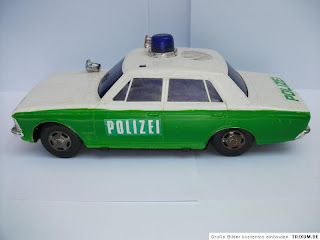
                          Many German police cars looked like this at that time.

            “That’s not ours,” I said. My heart beat faster, and the pastry in my stomach roiled. Maybe Jesus didn’t want me to go home again. Maybe He didn’t love me, after all. I grabbed Josefa’s hand, the only support I had left in this world. Josefa squeezed my hand and started crying again.
“Don’t cry,” the policeman said. He didn’t seem too upset. “I know of another place where your family probably is. Let’s go.”
He started the car and off we went. This time I watched the streets. I didn’t feel like admiring the stars anymore. What would happen to me if the policeman didn’t find our caravan home? Maybe I would die, since I was such a bad girl and couldn’t even take care of my sister. My eyes burned and tears threatened to come again. Then I remembered my prayer, and how peaceful I felt when it was over. Jesus would help. I sighed and closed my eyes. “Please, let us find our home,” I whispered so Josefa couldn’t hear. A sense of safety surrounded me.
The car went around a dark corner onto a dirt road. At the edge of the car’s lights, I made out two people running toward us. I thought they looked like our parents, but for a moment I wasn’t sure. I gripped Josefa’s hand harder. However, when they came into the light, it was our Vati and Mutti.
“There are my parents,” I yelled. Everything was okay now. I hadn’t hurt anyone, and the police had even helped me. Mutti would be mad, but that was okay, as long as I was home again.
The policeman stopped the car and said, “All right! I told you I’d find your family.”
He stepped from the car and talked to Vati. I opened the door and got out. Josefa scrambled after me.
Mutti bent and put her hands on Josefa’s shoulders. “Are you all right? God, I was so worried.”
I stood in front of the car, hands folded over my chest. Mutti let go of Josefa, turned to me and touched my face. “What happened? Where have you been?” she said. “We worried out of our minds. Vati and I were just on our way to the police.”
 “We got lost,” I said.
The policeman said good bye and shook our hands. “It was a pleasure to be able to help you two ladies.”
Josefa giggled.
Mutti gazed at me, frowned and shook her head. “Come on,” she said. She didn’t seem too mad. We scurried after her and Vati, back to our caravan home.
“We already ate,” Mutti said. “It’s late, but I’ve saved you some food. Hurry and eat and go to bed.”
“The nice policemen gave us some pastries,” I said. “I’m not hungry.”
“Me neither,” Josefa said.
Finally back in our warm home, we took off our clothes and washed our faces in the kitchen bowl before we went to bed.
Safely in my bed, I folded my hands and whispered a heartfelt “Thank you,” to Jesus.