Showing posts with label sisters. Show all posts

Monday, August 13, 2012

Josefa

Josefa at fifteen, and our Mutti

Until she was eighteen, Josefa worked at Atwoods architectural company during the week and with our Vati on weekends. Then she moved to Switzerland to be a nanny, after that to England, also as a nanny, and then to Paris, where she studied French. 

Before taking her interpreter exam, however, she returned to Germany, where she started attending classes for preparation to attend a university. While there, she met and married Alfred and quit going to prep classes. She started traveling with Vati again on the weekends, to make money and help out. 

Alfred and Josefa were married five years when she met an older man, an engineer who had just designed and built Vait's latest merry-go-round. It must have been a whirlwind romance,  because shortly after they met, she packed up her stuff while Alfred was at the university, finishing his classes for the day. When he arrived he found an empty home and a good-bye letter from her.

As soon as her divorce from Alfred was final, Josefa married Dieter  and helped him raise a son and a daughter from a first marriage. The daughter died shortly after, and Dieter and Josefa decided they wanted a child together. But that never happened. 

Years later, when Josefa was forty and had been married to Dieter almost twenty years, she thought she had started menopause. She went to the doctor, who shook his head, then grinned at her. 

"You're not in menopause," he told her. "You're expecting."

Josefa's lifelong wish came true when she was forty-one, and she became a mother to Theo, a very sweet young man now.

Josefa today

However, after the birth of the baby, Josefa's second marriage, also, deteriorated. They are still married now, but live separate lives in their big house in Bruchsal. Josefa does not want to change things, but when she visits any of her siblings, all she does is complain about her husband.

Josefa's son Theo at fifteeen

Wednesday, March 28, 2012

26 -- Jozef Returns from the Circus


Finally the show was over, and the three excited little boys burst out of the tent and into the late afternoon sunshine, closely followed by their two sisters, Karel, and a very upset Jozef.

Outside, on the circus grounds, the boys stopped short at the sight of the old elephant and the sign that was attached to a caravan next to the animal. An old, but familiar sign, announcing cheap elephant rides. For a moment, Jozef was a little boy again, foregoing the delight of such a ride just so he could talk to the prettiest creature he’d ever seen.
A voice took him out of his reverie. “Panje Wawrzyniak?” The oldest one of the boys tugged on his arm. “Maja said we could ride the elephant. Can we?”
In spite of himself, Jozef had to laugh. “Yes, you can.”
A line had already formed and the boys joined it, with their sisters and Jozef right behind them. Maja seemed skittish and unfocused. She said, “Can you make sure they get their ride, Panje Wawrzyniak? I want to look around a little.”
“No problem,” Jozef said. He also wanted to look around, wanted to find Nina, but he could not see her anywhere.
They had reached the head of the line. Jozef paid for the boys and made sure they were securely settled. Amidst shrieks of laughter, they let the elephant make its rounds with them.
Jozef stepped back, again searching for Nina. He saw Maja in the shadow of one of the caravan cages, talking to a slim young man and smiling up at him. He seemed familiar, but Jozef couldn’t place him. And it really didn’t matter. Probably a young man from another wealthy family in the area. The man smiled back at Maja and touched her hand. Good for her. Maybe she had finally found a suitor. He dismissed her from his mind, still looking for Nina, but couldn’t find her, neither deeper in the compound between the cages and caravans, nor among the crowds still milling around in the circus enclosure.
The boys were finished with their ride and Maja rejoined them just as the small group got ready to leave the circus compound. Their coachman was already waiting with the coach, the horses snorting impatiently. The boys filed in without taking a break in their excited retelling of what they had liked best in the circus. With one last, longing look at the circus, Jozef followed after the girls, and the family returned to the estate.

Thursday, March 22, 2012

21 -- The Priest Gives up His Priesthood

Two months later.

The sun shone into Jozef’s eyes. He woke, instantly remembering his changed state, as he had the last several days. Two weeks earlier, he and the bishop had come to an understanding, and Jozef had given up his calling as a priest. Even after these many days, it felt right. Once again he thought about having a family, but his heart wasn’t his to give away anymore. However, Maja was probably married by now, and even if she weren’t, he and Maja lived in two different worlds. She probably wouldn’t want him, a local man, even if she were still free.

He lay quietly, thinking. What his heart really desired, besides Maja, was a family. How nice it would be to have a loving wife and sons and daughters to play, laugh and spend time with. Now that he was not bound by the priesthood anymore, marriage could be a possibility. But was it fair to marry a woman while his heart belonged to another?

He shook off these depressing thoughts, rose and dressed in wholly unremarkable clothes. After breakfast, he finished the last of his paperwork on Konrad’s holdings to the west.

The late fall sun was still shining, and he decided to take a walk to the little town where most of Konrad’s peasants lived.

As he went on the path, admiring the red, green, and yellow foliage of the trees flanking the road, he caught up to three figures walking ahead of him. He squinted into the sun and recognized two as females, and one man. His stride being longer, he had caught up with them in a few minutes.

“Good morning, Fa…, Panje Wawrzyiniak,” Maja and Sylwia said in unison. The young man, Karel, bowed with a grin. Jozef had met him before. He came to see Sylwia, and everybody knew it.

Jozef doffed his hat and bowed. “Good morning to you, lovely ladies and gentleman. Where are you going, this early in the morning?”

Maja gave him her bright smile. “It’s such a beautiful day. We thought we’d take a walk to the village.”

Sylwia giggled. “She’s not telling you that the best seamstress lives there. We’ll probably visit her and look at her new material.”

Maja turned red.

Karel grinned. “And I’m out for a walk. But what better way to walk than with two beauties on each side?”

Jozef nodded. “How right you are.” He touched Maja’s shoulder. She was such a nice girl, even though she was almost past marrying age and a little heavy. She’d make a great wife to a lonely guy, and a wonderful mother one day. “It’s all right. You have the right to delight in beauty. Everybody does.”

“That’s for sure,” Karel said, but he never took his eyes off Sylwia’s.

Karel, Sylwia’s arm in his, walked on a little faster.

Jozef slowed down to give them some privacy. Maja matched his steps.

“Maybe I’ll have the seamstress make a new dress for my birthday next month,” she said.

More about these two tomorrow!

Sunday, February 26, 2012

The Scooter 2nd Part


Vati was reaching behind the picture with one hand while holding it in place against the carousel with the other.

In my excitement about maybe getting a new scooter for me and my siblings, I didn’t notice his irritated cussing at the screw. “Vati,” I called, “can we get a scooter for ten carousel tickets?”

Vati didn’t even turn to look at me. “No. Leave me alone. Now I dropped that &*&% screw.”

I stepped closer. If he’d just listen he would understand that this was important.

Before I could open my mouth again, he said, “Get out of here, now.”

I knew that tone of voice. If I’d persist now, he would push me, or worse, hit me, so I trudged back to the girls and Josefa, who was bent, inspecting the younger girl’s scooter.

I walked up to the older girl who looked at me expectantly. “My Vati won’t give me any tickets.”

“I guess I’d be happy with seven tickets, too,” she said.

“I can’t talk to him right now. He’s mad. Could you come back tomorrow?”

Josefa straightened and almost dropped the scooter. “Yes. Tomorrow. We’ll get you the tickets then.”

“And bring the scooter. Maybe if he sees it, he’ll give us the tickets.”

“Sounds good. I’ll bring it later.”

“Please?” Josefa chimed in. She looked at the girl with her bright, brown eyes and made her really cute face.

The big girl smiled at her.

The littler girl reached out her scooter. “Here. You can take a ride.”

I wandered off. Too bad I couldn’t make a cute face like Josefa could.

Mutti called me into the caravan home and gave me the new potato peeler we’d bought a little while before. “Here. Peel me six potatoes. It should go easy with this.”

Listlessly, I hacked at the potatoes, all the while thinking about that scooter. How we could whiz through each new town with that! All the other kids would be so jealous.

Josefa drifted in, and soon Mutti called out the caravan door, “Vati, Franz, essen kommen, come and eat!”

We finished our supper. When Vati was finished, he pushed away his plate and leaned back.


He grinned at me and Carmen and patted Franz on his head. “I got something for you children.”

Franz looked up. “What is it?”

The way I knew Vati, it probably was something that required us to help Mutti in the caravan home. But his next words confused me.

Vati focused on me. “It will keep you out from under your mother’s feet, I hope. Come on out and see.”

I rose and followed after Franz and Josefa.

Outside, leaning against the caravan steps, stood a brown scooter with red handlebars.

“Oh,” Josefa said, for once speechless.

Franz touched the handlebars. “Can I learn how to ride it, too?”

Vati patted his back. “Sure you can. But first, let your sisters try it out.” He turned to me. “Is that what you wanted earlier when you bothered me?”

I nodded. “Thank you so much,” I managed to say.

Carmen added, “We’ll take good care of it. I promise.”

And that was how we got our scooter. When we were traveling, it rode in the pack trailer, where Vati stored the carousel and the other attractions.

Franz soon learned to ride it too, and not long after, raced it down a steep declining street. He couldn’t brake in time and hit the wall at the end of the street. He had to have six stitches in his forehead.

Wednesday, January 25, 2012

Home Again!


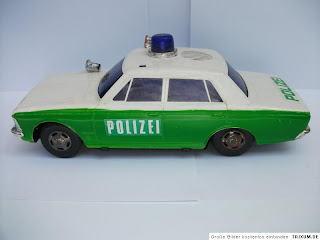
                          Many German police cars looked like this at that time.

            “That’s not ours,” I said. My heart beat faster, and the pastry in my stomach roiled. Maybe Jesus didn’t want me to go home again. Maybe He didn’t love me, after all. I grabbed Josefa’s hand, the only support I had left in this world. Josefa squeezed my hand and started crying again.
“Don’t cry,” the policeman said. He didn’t seem too upset. “I know of another place where your family probably is. Let’s go.”
He started the car and off we went. This time I watched the streets. I didn’t feel like admiring the stars anymore. What would happen to me if the policeman didn’t find our caravan home? Maybe I would die, since I was such a bad girl and couldn’t even take care of my sister. My eyes burned and tears threatened to come again. Then I remembered my prayer, and how peaceful I felt when it was over. Jesus would help. I sighed and closed my eyes. “Please, let us find our home,” I whispered so Josefa couldn’t hear. A sense of safety surrounded me.
The car went around a dark corner onto a dirt road. At the edge of the car’s lights, I made out two people running toward us. I thought they looked like our parents, but for a moment I wasn’t sure. I gripped Josefa’s hand harder. However, when they came into the light, it was our Vati and Mutti.
“There are my parents,” I yelled. Everything was okay now. I hadn’t hurt anyone, and the police had even helped me. Mutti would be mad, but that was okay, as long as I was home again.
The policeman stopped the car and said, “All right! I told you I’d find your family.”
He stepped from the car and talked to Vati. I opened the door and got out. Josefa scrambled after me.
Mutti bent and put her hands on Josefa’s shoulders. “Are you all right? God, I was so worried.”
I stood in front of the car, hands folded over my chest. Mutti let go of Josefa, turned to me and touched my face. “What happened? Where have you been?” she said. “We worried out of our minds. Vati and I were just on our way to the police.”
 “We got lost,” I said.
The policeman said good bye and shook our hands. “It was a pleasure to be able to help you two ladies.”
Josefa giggled.
Mutti gazed at me, frowned and shook her head. “Come on,” she said. She didn’t seem too mad. We scurried after her and Vati, back to our caravan home.
“We already ate,” Mutti said. “It’s late, but I’ve saved you some food. Hurry and eat and go to bed.”
“The nice policemen gave us some pastries,” I said. “I’m not hungry.”
“Me neither,” Josefa said.
Finally back in our warm home, we took off our clothes and washed our faces in the kitchen bowl before we went to bed.
Safely in my bed, I folded my hands and whispered a heartfelt “Thank you,” to Jesus.

Monday, January 23, 2012

Pastries for two Hungry Little Girls


Tasty Pastries for Little Sonja and Josefa - The Amerikaner on top and the Berliner on Bottom!

Ever since my experience in Wiesbaden, when I was nine, I liked the police. That night, in the warm police station, the policeman didn't seem mad.

He smiled when he asked me where we lived. I told him I didn’t know. He shook his head and led us into another, smaller room.
A brown paper bag stood on a large table with six chairs around it. Along the wall, under the window, a heater hissed and clanked. Warmth radiated from it. The policeman helped us take off our coats and told us to sit in two of the chairs.
“You must be hungry,” he said. “Would you like a pastry?”
Josefa and I nodded in unison. My mouth watered. The policeman allowed us to choose a pastry from the brown paper bag. Josefa found a Berliner, and the bag even held an Amerikaner for me. It tasted sweet and flaky, and I swallowed and took another bite, looking around me. Everything would turn out all right now. The policeman ate a pastry too. While we ate, other policemen entered, took pastries and talked to our policeman.
When we finished eating, he said, “Do you feel better now?”
We nodded.
“Now tell us what your Vati does and how you live.”
“We are from the carnival,” I said.
“Carnival? I didn’t know there was a carnival this late in the year.”
“We just arrived here. We are in winter quarters,” I said.
“There is another caravan home too, and pack-trailers,” Josefa added.
“Mmm,” the policeman said. “I think I know a few places.” He got up from his seat. “Let’s go and find your family.”
He helped us from the chairs and into our coats. Our small hands in his big ones, he escorted us to a green and white police car. We drove in the dark. The large lighted road gave way to smaller, darker streets. Soon we couldn’t see much of the neighborhoods we drove through. I leaned against the window and craned my neck. I saw the moon, a shallow scythe, and a few stars. How pretty the dark sky was! Jesus lived up there, and He had helped me find a way home. I was sure the policeman would take us straight home now.
The car stopped. When we got out, we saw a lighted caravan home in the dark. I started smiling, but then realized it wasn’t our home.

Sunday, January 22, 2012

I want to go Home!


I don't remember exactly, but the police station in Wiesbaden may have looked like this one.

Our caravan was the only home I knew when I was young, and that night I needed to find a way home with my sister on our first day of winter quarters in Wiesbaden. It never occurred to me to doubt that God would help me. After all these years, I still remember my anxiety and the simple trust I had in Jesus to be there for me.
When the stranger on the road said he couldn’t help us, my tired and cold knees grew weak. Please, dear Jesus, I thought, I want to go home.
I opened my mouth not knowing what to say, when the stranger added, “Come with me. The police will know what to do.”
Gratefully, I hurried after him, Josefa’s hand moored in mine. Surely this man knew what to do to find our home again. Maybe he was an angel, sent by Jesus. We followed him down the street to a police station.
He opened the door and I felt a sense of relief as we entered a well-lit, warm room. The man talked to a policeman for a while, pointing to us. He turned, smiled at us, and said, “The nice policeman will take care of you.” He tipped his hat and proceeded to the door, his shoes clicking on the tile. When he opened the door and left, a cold blast of air made me shiver all over again.
I gripped Josefa’s hand harder, turned, and stared at the policeman. The police help people, I thought. But a shudder went down my back, anyway. I looked down. Maybe he would be mad at me for being so stupid and losing my way and not taking care of my sister.


Friday, January 20, 2012

Still no Way Home


After my little prayer to the Jesus I had learned about in school the year before, I felt less frightened than before. I looked around, searching the dark street on that fateful evening in Wiesbaden. 
Shoppers rushed by. A tall man slowed and watched us from under the brim of his hat, then stopped.
“What’s going on here?” he asked. “Where are your parents?”
“We are lost,” I said.
Josefa cried again.
“Where do you live?” the man asked.
“I don’t know,” I said and swallowed my tears. “We just got here. We live in our caravan home.”
“Do you know where it is?”
“I think it’s that way,” I said and pointed forward.
           The man looked in the direction I pointed and shook his head.
“I can’t help you,” he said.

Wednesday, January 18, 2012

Turning to Christ


We were all alone on a busy street in Wiesbaden, and had no idea how to get home again. I was cold and hungry. Josefa sniffled, either from the cold or from suppressed tears.
 “Come on,” I said brusquely. I had to do something, and decided to go straight ahead.
But Josefa didn’t come after me.
“My feet hurt,” she said.
She stood rooted to the middle of the crowded sidewalk.
“Come on.” I stamped my foot.
 Josefa shook her head. Her face screwed up and two large tears rolled down her cheeks. She opened her mouth and wailed.
People jostled around us, ignoring our little drama. Cars roared by, and I barely heard Josefa’s wail in the din. The cold air smelled like Vati’s tractor when he turned it off.
I rubbed my hands. Why wouldn’t anyone help us? I turned to Josefa.
“Don’t cry,” I said. “My feet hurt, too. But we have to get home.”
Josefa didn’t move. She cried harder.
I swallowed my own tears and pulled on her arm.  “Shush,” I said. “If you want to go home, we have to keep going.”
Fear settled in my stomach like a hard stone. A sense of failure engulfed me. Instead of Carmen, I was finally in charge, and I had messed up. My responsibility for Josefa added to my fear. I needed to make things right for her. She depended on me, but I, myself, was helpless. How I wished I knew where to go!
Suddenly the thought of Jesus lit up my mind. Jesus would help. Just like He answered the prayers of the children in the pamphlets I read, He would help me too. But I better not let my sister and the people around see me pray. They would laugh at me.
Josefa was still crying. She wouldn’t hear me. So, instead of folding my hands, I balled them inside my pockets, screwed my eyes shut, and whispered quietly, so only Jesus could hear me, “Jesus, You love me. Please help us get back home. Please. Amen.”
I was still cold when I opened my eyes again, but the stone in my stomach had dissolved. The people around us may not care, but we were not alone.
I patted my sister on the arm. “It’s all right,” I said. “We’ll find the way home. Let’s go, okay?”
Josefa wiped her face with her sleeve and nodded.
However, I still didn’t know what to do.

Monday, January 16, 2012

Lost


On our first day in winter quarters when I was nine, my eight-year-old sister Josefa and I went into the town to get out of our mother's hair and to explore our new surroundings. We looked at things and when inspecting the goodies in a bakery, we got hungry and decided to go home again.
       I led Josefa to an intersection, where we turned into a street I thought would take us back. But when I looked around, nothing seemed familiar. The street was larger, not smaller, and traffic increased. In the gathering darkness, the lights in the stores along the street switched on. I swallowed a lump in my throat and pulled on Josefa’s coat sleeve. “Let’s go back to that intersection.”
Josefa looked at me with big, brown eyes and nodded. I bit my lip and surveyed the road as if I knew where to go. My sister trusted me. I was the leader and somehow I would find the way home. With renewed determination, I trotted back the way I thought we came. Josefa followed.
At the intersection I looked and looked, but couldn’t recognize anything familiar. How long had we been gone?
I suggested we turn another corner. “Maybe that’s where our winter quarter is.”
However, high buildings lined that street. Everything was dark. The buildings seemed to loom over us. Small windows dimly glinted in the light from the far off street lamps.
Josefa slowed. “Are you sure this is the way home?”
Now even the people were gone. We were all alone. My throat hurt, and I balled my hands into tight fists. I was older and needed to be an example for Josefa. I couldn’t let my fear show.
I told Josefa we should return to the larger street. At least there we could see something.
I shivered. Josefa stuck her hands into her armpits. Her breath burst out in little puffs of steam. My hands and feet ached from the cold and my stomach rumbled. How good a butter and jam sandwich would taste! But first we needed to get home.
I led Josefa to the next intersection and surveyed the streets leading from it. I recognized nothing. Suddenly I couldn’t breathe. My heart sped up to a gallop. I wanted to cry. People rushed around us on both sides, but no one noticed us, and nobody seemed to care.

Saturday, January 14, 2012

Checking out the New Neighborhood


 A typical, busy street in Wiesbaden, similar to the one Josefa and I checked out.

That first day of winter quarters in Wiesbaden, Josefa and I decided to get out of Mutti's hair and check out our new neighborhood. We went to the hook by the door, grabbed our coats and struggled into them while we barreled down the steps which Vati had already connected to the outside of the front door.
We meandered around the strange caravans. A tall, skinny man talked to Vati, a screwdriver in his hand. A woman stared out a curtained window, listening to them. She smiled without looking at us.
Josefa and I ambled along the fence and meandered down the path our tractor had come. Houses and shops beckoned in the near distance.
“Let’s see if there are any stores,” I suggested. “Maybe we can even find our school.”
“Yes, let’s.” Josefa sped ahead of me.
We turned a corner onto a paved road. A small bakery beckoned with cookies and pastries in the window. We sniffed the sweet smell of baked goods, and admired the wares through the window. A display of my favorite, a pastry called Amerikaner, the American, made my mouth water. The baker had placed the pastries, cone shaped and with white frosting on the top, in a pyramid of five on a plate. I imagined eating one, while Josefa pointed to the round doughnuts, called Berliner, covered in coarse sugar.
 We told each other how good they would taste, and went on. Soon a small intersection distracted us from our stomachs. We marched through it, to see what kind of other stores we could find.
The next road was asphalted instead of cobble-stoned, and cars sped by. Stores with large show windows lined it. Women with shopping nets bustled along the sidewalk, men with briefcases, bundled into warm coats, hurried around us. We looked, but didn’t see a school. The sun disappeared behind the buildings, and I shivered in my thin coat.
More to reassure myself instead of Josefa, I said, “Let’s go home.”

Thursday, January 12, 2012

Winter Quarters

                                          Our new car looked a lot like this one!

The winter I was nine, we stayed in Wiesbaden for winter quarters, where I would attend third grade more regularly. When we arrived in Wiesbaden, Vati pulled our caravan home through a drizzly, dark afternoon. I sat on the bolted-down bench in front of the kitchen table, hugging the wall and peering out the window in anticipation, wondering what our new winter quarters would look like.
I thought back to my first grade winter in Atzbach, the only town in Germany that had storks at that time. In the summers, they lived in a huge nest on top of the school chimney. I had still been there, attending school, when the storks arrived in the spring. I loved these great, ungainly birds. Too bad we couldn’t go back to Atzbach. It would have been so nice to see the storks again.
But last year hadn’t been bad, either. That was my second grade year, and we spent that winter in Weilmünster. Vati had exchanged his old BMW motorcycle for a black VW bug with two tiny, egg-shaped rear windows, and blinkers that came out on the outside of the car, like little red flags. But the most exciting thing that year was the birth of our youngest sister Eva.
Now, once again on our way to winter quarters, the rubber tires of our home rolled along the ruts of the path, pulled by Vati’s old Deutz tractor. With every jolt, the caravan swayed. A large open field, fenced in on two sides and the back, seemed to be Vati’s goal for our caravan. Weeds grew like a small forest along the sides. Close to the fence on the right snuggled three other caravans, painted a light blue in contrast to our dark brown ones. One of them seemed a home, recognizable by the curtains in the windows. Two unfamiliar pack trailers flanked it, probably holding a carousel and other carnival attractions. I searched the windows of that caravan home. Maybe the family had children, and I’d finally have a friend for more than a week. I couldn’t wait to go outside and see.
Vati maneuvered our home around the other caravan and positioned it next to our pack trailer, which he had towed there the day before.
The Deutz made one more “chug,” and stopped. Mutti unwrapped the radio from its blankets on the sofa and placed it on the shelf over the coffee table. She directed Carmen to unlock the cabinets in the kitchen. Eva, ten months old, sat in her playpen in a corner of the living room, watching the commotion. Josefa and I stood by the sliding door that divided the kitchen from the living room, craning our necks to see what Mutti was doing.
“Get out of my way,” Carmen said as she rushed by me and Josefa. Little Franz, bundled in his jacket, pushed through and went outside, trailing after Vati, who connected our caravan home to the electricity and made sure everything was settled.
Mutti squeezed around Josefa to get into the kitchen. “You’re in my way. Why don’t you two go outside for a while,” she suggested.
I looked at Josefa, who must have felt as out of place as I did in our cramped home. I had an idea. “Let’s explore the new place.”
Josefa’s eyes lit up. We went to the hook by the door, grabbed our coats and struggled into them while we barreled down the steps which Vati had already connected to the outside of the front door.

Monday, January 9, 2012

Uncle Henrik


 Uncle Henrik (shown here as a young man working as a hired hand for the Nazi owner) was the lion tamer in the Circus Francesco. After the war in Poland, he became somewhat of a celebrity when he was the first person who successfully bred a lion with a tiger. The resulting cub is called a liger.

***


A year after I was supposed to go to Poland, our family received their second visit from a family member.

It was around Christmastime, and I had settled into going to the same school for the winter. One day I came home and found a stranger sitting at the kitchen table with Vati. In front of them stood a half-empty vodka bottle and two shot glasses. Vati was talking to the stranger in what I thought was Polish.

Mutti came from the livin groom and said, “Henrik, this is our second, Sonja.” She turned to me. “This is your uncle Henrik.”

I remembered that Vati had talked about his brother coming to visit from Poland, but had forgotten all about it.

I stretched out my hand and the stranger took it. “Hallo Sonja,” he said gravely.
Carmen and Josefa burst in after me, trailed by Franz. Mutti shooed me into the
living room and introduced my sisters to Uncle Henrik.

“And this is our son, Franz. He’s named after your father.”

Uncle Henrik rose and hugged Franz, who squirmed in the embrace of this stranger. When Henrik was about to sit down again, Mutti touched his arm. “Why don’t you and Colya go into the living room. I have to start supper now.”

Vati rose, and as he went through the open sliding doors into the living room, he stumbled against the edge of the door and mumbled something in polish. Uncle Henrik grabbed the bottle and the two glasses and followed him.

Mutti came after him. “Carmen, Sonja, Josefa, come here. You have homework to do. Eva, you come too.”

Uncle Henrik said something in Polish to Vati. “Franz, join us,” Vati called. “You’re the only man among all these women. You drink with us.”

Nine-year-old Franz stood in the doorway, not moving. Mutti took his arm and looked around him into the living room. “You will not give this child any vodka, Colya. You and Henrik can drink all you want, but Franz will stay here. He is a child, understand?”

Vati looked at Henrik who took another sip from his glass. “You women. Always meddling,” he mumbled and then slipped back into Polish. Soon he had forgotten all about it, and laughed and talked with Henrik while we sisters, and Franz, too, finished our homework, with Eva playing on the floor.

Mutti finished a large plate of open-faced sandwiched for us children and carried a smaller plate into the living room. We ate, listening to Vati and Uncle Henrik talk, hoping in vain to understand something.

After supper, Mutti got Eva ready for bed and shooed us off to sleep long before our usual bedtime. I heard Vati, Mutti and Uncle Henrik talk and laugh until I drifted off to sleep.

Uncle Henrik stayed a week. He was not talking much to us children, I assumed because he didn’t understand much German, but he was always friendly and sometimes a little too friendly, trying to hug and kiss us. Our parents never hugged or kissed us, so it seemed weird to me that a strange men, eve if he was an uncle, would do that. But somewhere deep inside I loved it!

 When Uncle Henry left, he gave Mutti several kielbasa hard sausages and other Polish food. I will never forget the wonderful taste of kielbasa in lentil soup, kielbasa sliced on a piece of bread, and kielbasa with sauerkraut.

I never saw Uncle Henry again after he left.

Wednesday, January 4, 2012

Brigitte


Brigitte, Mutti’s sister was nine years younger than Mutti. When I was very small, right after the war, Brigitte once came to live with us in our tiny caravan. By then Mutti had Carmen, Josefa, and me, and my little brother was a newborn. Brigitte was supposed to help out with us children. But it didn’t last long before both sisters lost their patience with each other and Brigitte left again.

She rarely wrote after that and never visited again until I was a teenager and we had left the carnival circuit. Mutti had separated from Vati and lived with us girls and baby Michael in an apartment.

One day, a knock came at the door. Eva, my little sister, opened the door and a strange woman with light brown hair and blue eyes, and obviously pregnant, asked for our Mutti. Mutti called her Brigitte and pulled her into the apartment.

Brigitte had nowhere to go, so she lived in my older sister’s room for a few weeks, while Mutti and she tried to find her a job and a place of her own. Eventually Brigitte found work at the hospital in Wetzlar, a few miles away, and moved out. She never contacted my mother again, and we still don’t know what happened to her. Mutti is 91 now. When I visited her last, I asked about her sister. Mutti didn’t know whether she was still alive or where she lived. I don’t think either sister cared too much for the other.

A few years earlier, when I was twelve, we had another family member visiting. I’ll talk about that soon. Now I’m getting ready to take out my own little surprise visitor, Liesel, and her sisters!