Showing posts with label mothers and daughters. Show all posts

Sunday, February 12, 2012

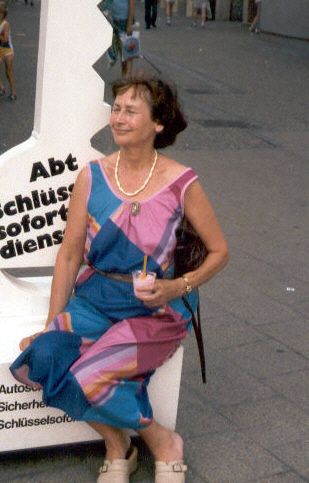
Elfriede Markus

Elfriede Edel as a Young Widow


 Mutti’s mother was a widow when Mutti was four years old. She was young and pretty, and wanted to have a man in her life. She went out dancing and having fun while leaving the little girl all alone at home. Eventually she married again, and her name changed from Elfriede Edel to Elfriede Markus.

Elfriede was very young when Mutti was born. She was far from her family and didn’t really know how to raise a child. In many ways, Mutti was emotionally and physically abused. She told me a few years ago that parents of that time hit their children and rarely praised them as a matter of course.

 My wedding in 1973. Elfried and Max are in the front, with my baby brother Michael between them. I'm right behind Max, and my father is next to me with my sister Josefa. Mutti is on the right behind Elfriede, with my husband Gary next to her.

And that’s the reason why I never met my grandmother Elfriede until my wedding at 23. When Mutti was still small, she swore she’d never hit her children. When the war was finally over, Mutti was six months pregnant, so she and Vati got married as soon as they could, with no one of Mutti’s family in attendance.

A year or so later, before traveling to Berlin became very difficult, Mutti and Vati visited Max and Elfriede Markus in Berlin. Then they took their circus back to Hessen, the heartland of Germany. Mutti had no contact with her mother. They never wrote each other. Telephoning was out of the question because of our constant travels. My grandmother must have tried to visit when I was small, but I don’t remember that. When we were older, Mutti told us children that she had no wish to have her mother close to her children, because she was afraid Elfriede would hit us. She didn’t want that, and she didn’t want to deal with her mother.

However, by the time I was 23, they had contacted each other again, and my grandmother was invited, and came, to my wedding. I never met her again after that.

But even though I grew up without grandparents, I hope I have become a pretty good grandmother! I enjoy being a grandmother very much!

Monday, February 6, 2012

More About Mutti


 Mutti in 1998

Provo, Utah, 1998

My last three children, now teenagers, my husband, and I picked Mutti, now 78 years young, up from the airport. Her coal black hair was streaked with rusty red, the gray covered up. Her black eyes, now imbedded in wrinkles, were as alert and expressive as ever. She was excited to be in America. And for me, it was time to finally keep the promise I made to myself so long ago, to have her tell me her story. 
A few days into the visit, I asked her if it would be okay if I interviewed her about her youth.

“There are still some things that are hard to talk about,” she said, “but it’s time to tell the story.


“I’m going to write a book about your life,” I told her.


Mutti laughed. “We’ll see. But even if you don’t, the story needs to be told.”


The next day, armed with three empty 90-minute tapes and a tape recorder, I entered the kitchen where Mother sat at the table drinking coffee.


“Are you ready?”


Mutti put down her coffee and nodded. I showed her how the tape recorder worked and started her talking with a question. “What was your father like?”


And she told me. The story spilled out and I taped for hours, filling all three tapes. I listened, entranced, to a life undermined by the Nazis, the life of
a scared young woman in Hitler’s Germany, who wanted nothing but a little happiness in her life. This is a story that should never be forgotten.

As I listened, I started to understand why Mutti had been so distant when I was a child, but as a child, I saw the lack of love in our lives as normal. 


Later, I transcribed my mother’s story, and then used it as an outline for a novel. The book is finished, but not yet sold to a publisher. Hopefully, that will happen in the near future, too.

Read the first chapter here: Walk on a Wire.

Saturday, February 4, 2012

Deciding my Future

 Thank you Alexandrea Zenne, for this beautiful picture of a tightrope walker! That's how I imagined a high wire walker to look when I was in fifth grade!


Germany, 1958 

My paper on Icarus and Daedalus had received an “A” in the fifth grade class I attended that week. In spite of my haphazard education and in my childish enthusiasm, I decided I would be a writer one day. And the first thing I would write about would be Mutti’s life. I ran home, full of excitement.

Mutti stood in the kitchen of our caravan home, stirring soup in a pot and listening to soft music coming from the radio in the living room.

Over the sound of the music I heard my siblings outside, helping Vati put up the merry-go-round. Good. I had Mutti to myself for a few minutes, and she seemed in a good mood. Now was the perfect time to do some research for my future writing career. 

I leaned against the counter opposite the stove. “Why did you join the circus Mutti? And how did you find it? What did you do in the circus?” I half expected her to brush me off, but she didn’t. 

A far-away look settled in her eyes, and she sighed. “That was a long time ago, child. I needed to get out of Berlin, and the circus seemed the perfect solution. It was a way out of all my trouble.” She stopped, turned the propane fire under the pot to low, and pulled a chair from the kitchen table.

I slipped into the converted bus seat Vati had screwed to the floor between the table and the wall. “Did you need to leave Berlin because of Hitler?”

“Yes. The Nazis were everywhere. I was lucky to find the circus.”

“Did you meet Vati there?” 

“Yes.” 

Enveloped by the enticing aroma of oxtail soup, we sat at the kitchen table. Mutti told me about how she met my father. I listened, as quiet as the circus audience when the tightrope walker performs. Mutti rarely talked about her life, but as long as I could remember, I knew she was half-Jewish and hid from Hitler during the war. I watched her, still so beautiful, talk about a past that was surely more bitter than sweet, and knew I would one day write the story of her life. 

And I have!

Tune in for more soon!

Wednesday, January 25, 2012

Home Again!


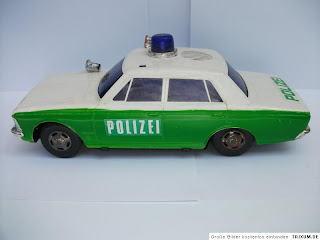
                          Many German police cars looked like this at that time.

            “That’s not ours,” I said. My heart beat faster, and the pastry in my stomach roiled. Maybe Jesus didn’t want me to go home again. Maybe He didn’t love me, after all. I grabbed Josefa’s hand, the only support I had left in this world. Josefa squeezed my hand and started crying again.
“Don’t cry,” the policeman said. He didn’t seem too upset. “I know of another place where your family probably is. Let’s go.”
He started the car and off we went. This time I watched the streets. I didn’t feel like admiring the stars anymore. What would happen to me if the policeman didn’t find our caravan home? Maybe I would die, since I was such a bad girl and couldn’t even take care of my sister. My eyes burned and tears threatened to come again. Then I remembered my prayer, and how peaceful I felt when it was over. Jesus would help. I sighed and closed my eyes. “Please, let us find our home,” I whispered so Josefa couldn’t hear. A sense of safety surrounded me.
The car went around a dark corner onto a dirt road. At the edge of the car’s lights, I made out two people running toward us. I thought they looked like our parents, but for a moment I wasn’t sure. I gripped Josefa’s hand harder. However, when they came into the light, it was our Vati and Mutti.
“There are my parents,” I yelled. Everything was okay now. I hadn’t hurt anyone, and the police had even helped me. Mutti would be mad, but that was okay, as long as I was home again.
The policeman stopped the car and said, “All right! I told you I’d find your family.”
He stepped from the car and talked to Vati. I opened the door and got out. Josefa scrambled after me.
Mutti bent and put her hands on Josefa’s shoulders. “Are you all right? God, I was so worried.”
I stood in front of the car, hands folded over my chest. Mutti let go of Josefa, turned to me and touched my face. “What happened? Where have you been?” she said. “We worried out of our minds. Vati and I were just on our way to the police.”
 “We got lost,” I said.
The policeman said good bye and shook our hands. “It was a pleasure to be able to help you two ladies.”
Josefa giggled.
Mutti gazed at me, frowned and shook her head. “Come on,” she said. She didn’t seem too mad. We scurried after her and Vati, back to our caravan home.
“We already ate,” Mutti said. “It’s late, but I’ve saved you some food. Hurry and eat and go to bed.”
“The nice policemen gave us some pastries,” I said. “I’m not hungry.”
“Me neither,” Josefa said.
Finally back in our warm home, we took off our clothes and washed our faces in the kitchen bowl before we went to bed.
Safely in my bed, I folded my hands and whispered a heartfelt “Thank you,” to Jesus.

Tuesday, January 10, 2012

Oma


Mutti's mother (my grandmother), in the photo Mutti showed me.

The last time Mutti visited me from Germany I made it my goal to talk to her about her childhood and about mine. Even now, after all these years, there are some things we cannot talk about. However, Mutti loves to talk about her childhood and youth.
This is a recreation of one of our conversations.
Mutti has been with us for a week now. We still have two more weeks before she has to fly back to Germany again.
One morning Mutti comes downstairs, an unfamiliar photo album under her arm. She smiles at me. “I brought some pictures.”
We sit on the sofa, and Mutti opens the album. She points to a yellowed black and white photo of a young woman walking down the street, wrapped in a fur coat. A large hat shadows her face, and her expression tells of self-confidence and an awareness of her own beauty.
“That’s my mother,” Mutti says. “She was still young, and she wanted to have some fun and be married again after my father’s death.”
“How old were you when your father died?”
“About five. After my Vati died, Mother used to go out a lot. Sometimes she’d come home with a new boyfriend, and then she told me to go out and play.”
Mutti smiles. “That was before Hitler rose to power. After Vati passed away, I became a real street urchin. My friend’s mother was a widow too and worked all day. So Mädi and I used to play in the streets after school. We knew that whole area of Berlin like our backyards. We never got lost or in trouble.”
I think of my own childhood, where I was in a different town every week or so. “It must have been nice to grow up in one place.”
“It was. I never grew tired of being outside. After my mother remarried, I still spent a lot of time outside, just to be out of her hair, especially when Max was home.”

Mutti flicks through the pictures. I had never met her mother, which is my grandmother, until I got married at 23, right before I left for the United States. I realize Mutti's childhood probably wasn’t what she remembers now. It must have been hard for her to have been on her own all the time. Even now, Mutti doesn’t realize how unloving her own mother had been.

Wednesday, January 4, 2012

Brigitte


Brigitte, Mutti’s sister was nine years younger than Mutti. When I was very small, right after the war, Brigitte once came to live with us in our tiny caravan. By then Mutti had Carmen, Josefa, and me, and my little brother was a newborn. Brigitte was supposed to help out with us children. But it didn’t last long before both sisters lost their patience with each other and Brigitte left again.

She rarely wrote after that and never visited again until I was a teenager and we had left the carnival circuit. Mutti had separated from Vati and lived with us girls and baby Michael in an apartment.

One day, a knock came at the door. Eva, my little sister, opened the door and a strange woman with light brown hair and blue eyes, and obviously pregnant, asked for our Mutti. Mutti called her Brigitte and pulled her into the apartment.

Brigitte had nowhere to go, so she lived in my older sister’s room for a few weeks, while Mutti and she tried to find her a job and a place of her own. Eventually Brigitte found work at the hospital in Wetzlar, a few miles away, and moved out. She never contacted my mother again, and we still don’t know what happened to her. Mutti is 91 now. When I visited her last, I asked about her sister. Mutti didn’t know whether she was still alive or where she lived. I don’t think either sister cared too much for the other.

A few years earlier, when I was twelve, we had another family member visiting. I’ll talk about that soon. Now I’m getting ready to take out my own little surprise visitor, Liesel, and her sisters!

Tuesday, January 3, 2012

The Visitor


When my husband and I came home after spending the afternoon on New Year’s with a married daughter and her family in the area, we saw a strange car in the car park.

“Whose car is that? It doesn’t look familiar,” Ken said. “Maybe it’s Marit.”

Our daughter Marit had moved here from California two months ago. I shook my head. “These are not California license plates. And it doesn’t look like her car.” The plates looked very familiar, but I couldn’t place them, so I said. “They are Colorado plates.” Marit had just returned from a month’s long stay in Colorado with her grandmother, and Colorado was on my mind.

Ken parked behind the strange car, and as he got out he said. “They’re not. It can’t be anyone but Marit.”

But Ken was right. Colorado plates didn’t have a picture of a pine tree in their center. But I knew those plates. Where had I seen them before? As I exited the car, the door to our home opened. In the dark, all I could see was a fluffy blonde head of short hair. Did Marit cut and color her hair since I saw her last a few day’s ago?

Ken, several steps in front of me, spread his arms wide. “Is that really you?” Delight rang in his voice as he enveloped the woman who had come from our home in a bear hug.

At that moment I knew who it was! I squealed in delight and joined them. We had a group hug on the porch before getting into our home.

We still have two daughters and a son living in Oregon, where we had raised them for eight years before packing up and moving to Germany for two years, and then back to Utah.

The little girl who gave us our best Christmas surprise was Liesel, on of our daughters from Oregon. We had no idea she would come, and her arrival made the best surprise. Liesel will be with us until her birthday on Sunday, before leaving back to Oregon.

***

When I was a girl growing up in the carnival in Germany, we only had our parents and us children. We heard about grandparents and aunts and uncles, but they were far away. However, we had relatives visiting too, once or twice in all those years. I’ll write more about that tomorrow.

Thursday, December 29, 2011

Chicken, Potatoes, and Raisins!


Oh, the joys of eating chicken! Chicken Cordon Bleu with melty sweet Swiss cheese and crisp crumbs on the outside is one of my favorite chicken dishes. Chicken in yellow gravy, made from a can of creamy chicken soup and poured over potatoes can still make my mouth salivate.

That day so long ago, we ate chicken and self-picked dandelion greens with young nettles, and it seemed every bit as delicious to the little girl I was, as an expertly prepared Chicken Cordon Bleu would taste today.

After we ate, Mutti saved the rest of the chicken. The next day, she cut it into small pieces and heated them in a yellow gravy. We had boiled potatoes with it. What a delight!

We had potatoes every day. They were cheap and grew well in Germany after the war. I never got tired of them, and I still love them.

That evening, supper consisted of raisin bread with margarine and an apple. Carmen said, “Yuck! I hate slimy raisins,” and picked them out.

“Don’t be so dumb,” Mutti said. “Raisins are good for you.”

But Carmen pushed her little pile of raisins away.

Josefa watched with wide eyes. “Yucky,” she said, and picked out her raisins, too.

Mutti said, “Little brats.” She picked up Carmen’s raisins and ate one. “Oh, well. More for the rest of us.”

I, too, poked a raisin out of my slice of bread and tried it. Carmen was right. They were slimy and gushy and icky. But I wanted to make Mutti happy. I swallowed it.

Mutti smiled. “At least Sonja eats them,” she said. “She’s a good eater.”

Pride swelled my breast. I smiled at my sisters across the table.

Vait took a swallow from his coffee cup. “She eats so much, but never gains weight. Maybe she’s sick.”

I wasn’t worried about being sick. Mutti was pleased with me, and Vati was thinking about me. I resolved to always be a good eater, so Mutti would approve.

Today I have learned to love raisins, especially in hot oatmeal. And I do have to rein in my appetite so I can stay healthy!

Tuesday, December 27, 2011

Greens


One sunny autumn morning, when I was maybe four or five, Mutti turned to Carmen and said, “Watch Franz. I’ll have to find something green for lunch.”

She called Josefa and me, put on her gloves, even though it was warm outside, grabbed her shopping basket, and left. We hurried after her in the morning sunlight.

Mutti strode along the street of the little village we held our carnival in that week. We passed a big building that may have been the city hall. Long slats of wood were all over it, and they almost hid the big burnt hole in the upper story. People climbed all over the wood, working on the broken bricks.

When the sidewalk ended, Mutti turned into a path marked with grassy ruts. Josefa and I hurried to keep up with her. We tried not to stumble on the uneven ground. The damp grasses left cold streaks on my bare legs.

We reached a small pond, and Mutti stopped. Stinging nettles grew in profusion by the pond, their dark green fleshy leaves crowding out other grasses. Mutti checked her gloves and broke off the smaller nettles, piling them into the basket. Josefa was reaching out to copy Mutti, but Mutti slapped her hand away.

“Don’t do that,” she said. “They’ll sting you.”

“Yeah,” I said. “You don’t know anything.”

Josefa kicked my leg. I screamed and hit her. She started crying.

Mutti ignored us.

I ran from my sister, being careful not to touch the nettles. Josefa quit crying, sat in the grass, and played with a dandelion.

When the basket was almost full, Mutti turned toward the meadow on the other side of the path. She picked the dandelion leaves and piled them on top of the nettles. Some of the blooms had turned a gossamer gray and Mutti left them alone. When I picked a gray one and blew on it, the gray dissolved into many tiny parachutes, which floated softly in the breeze.

Josefa and I ran around the meadow, picking dandelions and blowing them, until Mutti yelled at us. We trudged back after her past the bombed out city hall to the grassy commons, where Vati had already put up the back and sides of the shooting gallery in front of our caravan.

Vati stopped working, picked something white from the ground next to the half-erected shooting gallery, and followed us to the caravan home. He held up a dead chicken, his broad hands grasping it firmly by the feet. Its head dangled from under its white, feathered body, wings half-spread. The eyes were closed and its beak stood open. I thought the chicken looked sad.

“I exchanged this for free tickets,” Vati said and smiled.

Mutti put down her basket and clapped her hands.

“We’ll have a feast today,” she said and took the chicken. She shooed Carmen and Franz from the caravan, but left the door open. Franz sat down by the steps and played in the dirt. Josefa and I watched Mutti.

Mutti put the chicken in the wash bowl. Its head dangled over the rim and she tucked that into the bowl too. The feet were sticking straight up. After she heated water on the coal stove she took the chicken outside and poured the boiling water over it. Then she left and let it sit on the caravan steps for a while.

Josefa and I turned to play with Franz who drove an imaginary car through the dirt, making car noises.

When I looked up again, Mutti sat on the steps, plucking the feathers off the chicken. They fell in an untidy heap next to the caravan home’s wheels. When she was done, she cut the belly of the chicken open and dug out the insides.

I watched, eyes and mouths open.

Josefa joined me. “Yuck,” she said.

Mutti pulled out the intestines. “Most of this isn’t good to eat. But the rest will taste great.” She looked at Josefa. “If you don’t want it, we’ll eat it for you.”

“I want it, I want it,” Josefa said, but she sounded doubtful.

Mutti rose and took the chicken inside.

For lunch we had potatoes with green stuff, made from the greens we and Mutti had picked that morning, and parts of the chicken.

Carmen and Josefa each got a foot. Mutti showed them how to strip the scaly skin off the foot and lower leg and eat the meaty gristle from between the bones. I got the head. I cracked it open and ate the brains out of it. It was delicious, much better than the greens we helped Mutti pick.

***

Many years later, in my spacious kitchen in America, I remind Mutti of the chicken head. “I couldn’t eat that now. But then it tasted delicious.”

“I remember,” Mutti says. “We did what we had to. My children never went hungry.” She sighs and helps me finish washing the dishes.

Saturday, December 24, 2011

Spinach Part Two


Margot sat in front of the mess on her table, not moving. If she’d try again, she’d throw it up again. But what else could she do? Eventually she took the spoon again, scooped up a fresh, smaller part of the mess and swallowed it quickly. Her stomach heaved, but she took a deep breath and it stayed down.

Mutti glanced up from her paper. “There you go. Now eat the rest and don’t be so stubborn.”

Margot didn’t dare to eat another bite. The spinach in her stomach felt as if it wanted to crawl up her throat. There must be something wrong with her. Other people ate spinach, why couldn’t she? She hung her head.

Brigitte’s cries from the hallway faded. She must have fallen asleep again.

Margot stared at the spinach for an eternity. Finally the front door slammed.

Mutti rose. “Is that you, Max?”

Max came in. A raindrop glistened on his nose. “Hi Elfriede, hi Margot.” He put his lunchbox onto the table and kissed Mutti on the cheek. “What’s going on? It’s after four. What’s Margot doing still eating?”

Mutti’s forehead creased. She glanced at Margot, eyes hard and cold like ice. “You know how she is. She’s determined not to eat her spinach, no matter what. And I’m determined that this time, for once, she will.”

“But I don’t like it,” Margot wailed.

Max came closer, staring at Margot’s plate. He pointed. “Is that throw-up?”

Margot shrunk tighter into her chair. In spite of her efforts, hot tears squeezed from her eyes. “I’m sorry.  I couldn’t help it. It just came up again. I tried to eat it. I really tried.”

Without another word, Max turned, took Mutti by the elbow, and pulled her into the hallway. The kitchen door snapped shut.

Margot swallowed. Maybe this was her chance to rinse the mess into the sink. But if Mutti would catch her again, she’d beat her with the wooden spoon, besides making her eat it. She couldn’t risk it. She stared at her plate without seeing it. Her bottom was hurting from sitting in the hard chair for so long.

The door to the hallway opened. Max came in.

Faintly, Margot heard Mutti in Brigitte’s room, talking to her in that soothing, sing-song voice she used for the baby.

Max marched up to her, took her by the elbow, and pulled her out of the chair. “Go into your room and don’t come out again for the rest of the day. I’ll bring you a sandwich in a while.”

Margot turned to him. “And I don’t have to eat that spinach anymore?”

“No, you don’t. Your mother will be fine in the morning. Just stay out of her sight today.”

Margot threw her arms around his waist. “Thank you! Thanks so much.”

Max disengaged himself from her embrace. “Hurry up now. I’ll see you later.”

Margot tiptoed past Brigitte’s open bedroom door and gently shut the door to her room behind herself. She threw herself on the bed and buried her head into her pillow. She might be a bad girl because she couldn’t please her mother, but if she ever had children, she would never make them eat stuff they didn’t like, especially not spinach.

***

And she never did.

Thursday, December 22, 2011

Spinach, Part One


Oh, the joys of good food! The first time I tasted a hot artichoke spinach dip with celery, I thought I'd never eat something that tasty again. But different foods mean different things to different people.

Even if they had artichoke spinach dip in Germany, I know my mother would never want to even try it. Here is the story of little Margot (my mother's name) and her relationship to spinach.

Margot unlocked the door to the apartment, slipped in, and shrugged her satchel from her shoulders. She sniffed the air and her stomach tightened. She was hungry, but that smell!

She stood in the hallway, coat still on her slight ten-year-old frame. Maybe Mutti was in a good mood today and wouldn't make her eat it. 

“Is that you, Margot?” Mutti’s voice came from the kitchen. “Hurry up, food’s on the table.”

Margot stretched to hang her coat on the hook, pushed her satchel under the coat rack, and hurried down the hallway to the kitchen.

Little Brigitte sat in her wooden high chair, waving her spoon in the air. Mutti looked up from putting mashed potatoes onto the plate in front of Margot’s chair. “How was school?”

Margot pulled the chair out and sat down. “Fine.” She shrugged. “What are we having?”

“Mashed potatoes, spinach, and eggs.”

Margot’s shoulders slumped. She’d hoped against hope…

Mutti ladled a large glob of pureed spinach onto her plate.

Margot suppressed a shudder. It looked like a fresh cow patty and smelled like one too. She looked up. “Can I just have eggs and potatoes, please?”

Mutti placed a fried egg on top of the unappetizing mess. “No. You need to eat your spinach, too.”

“I don’t like it.”

“Oh well. I’ll take some off.” Mutti scooped a tablespoon of spinach from under the egg and plopped it on her plate. “But you need to eat the rest of it.” Mutti turned and put a plate with a cut up egg, some spinach and mashed potatoes in front of two-year-old Brigitte, next to her at the table.

Margot carefully removed the egg from the cow patty of spinach and ate it. She stirred a little spinach into her mashed potatoes and put the mix into her mouth. If she concentrated on the taste of the potatoes, it wasn’t too bad. Before she knew it, though, the potatoes were gone, and the pile of spinach looked even larger than it had before. She opened her mouth to ask Mutti if she couldn’t get up. After all, she ate some of the spinach.

At that moment, Brigitte waved her pudgy arm and swiped her bowl onto the table. It hit her glass of milk on the way down and milk spilled all over Mutti’s apron and dress.

Mutti jumped from her seat. “Darn brats,” she muttered and wiped her face with her cloth napkin. She jerked Brigitte from the chair. Brigitte wailed.

“You’re done eating,” Mutti hissed. She dragged the soggy napkin over Brigitte’s face and hands, and left the kitchen with her. Brigitte’s screams faded into the hallway.

Margot looked around. Maybe she could rinse the spinach down the sink while Mutti was gone. As she rose and grabbed her plate, Mutti stormed back in. “What do you think you’re doing?” She grabbed Margot’s plate and pushed her back into her seat. “You stay here and eat your food.”

“But Mutti! I don’t like it!” Margot wailed.

“I don’t care. You stay here and eat, if it takes the whole day.”

Maybe if she sat really quiet and didn’t move, Mutti would let her go eventually.

Mutti finished her plate, then cleaned up the mess Brigitte had made and washed the dishes.

Margot fidgeted. “Mutti…”

“Don’t you say another word. You finish your plate. That’s that. No more discussions.” Mutti wrung out the dishcloth and wiped the table around Margot.

Margot shrunk into her seat, staring at the spinach. It seemed to glare back at her. She glanced at Mutti. Spinach couldn’t be too bad. Mutti ate it. The green goo on her plate seemed to grin. Margot grabbed the spoon, scooped up a large spoonful, and stuck it into her mouth. The stuff was slimy, as expected, but now it was also cold. I’ve got to eat this, Margot thought and swallowed. The gooey stuff slid coldly down her throat. Suddenly an image of a cow doing its business came into her mind.

Her stomach convulsed and without being able to help it, Margot threw the spinach back up onto her plate.

Mutti dropped the dishcloth into the sink, and stormed to Margot’s chair. Her hand connected with Margot’s wet cheek. “Darn brat! You did that just to spite me. You will eat this, no matter what!”

Margot bit her lip and squeezed her eyes shut. Crying would just make Mutti madder. She shrank into her chair and wrapped her arms around herself.

"Mutti, Mutti," A sleepy voice sounded from the hallway.

“You stay there and eat this,” Mutti yelled. “I’ll be watching.” She grabbed the newspaper and sat opposite Margot, ignoring Brigitte’s cries.

Tuesday, December 20, 2011

Food

The next few entries will be about food. About Mutti and food when she was little, about food after the war in Germany, and about food in our little caravan when I was a child.

Let's start with an account of Mutti's and my relationship to food. This is a dialogue between Mutti and me when she visited me in the States a few years back.


 I’m in the kitchen, preparing a late breakfast. I’m frying bacon and eggs.

“Oh God, no,” Mutti says. “I can’t believe you are eating that for breakfast. You have to watch your figure. You’re not skinny anymore.”

“It’s common in America. When you eat breakfast late, you make bacon and eggs and skip lunch,” I explain.

Mutti sighs. For her, breakfast consists of bread or cereal and coffee. “Sure you’ll skip lunch,” she says. “Please, none of that for me.”

Mutti wasn’t raised in the Jewish faith. She doesn’t disapprove on religious grounds. Many times, when I was small and we could find and afford it, we had pork chops for lunch.

I smile and assure her she won’t have to eat eggs and bacon.

An hour later, after we finished eating (Mutti had Müsli and coffee, while Ken and I enjoyed our bacon and eggs), my 17-year-old gets up. She comes from her room and rummages in the refrigerator. “What’s there to eat?”

“We already ate, just a little while ago,” I answer. “Eat whatever you can find.”

After some more rummaging, Liesel settles on a peanut butter sandwich. She gulps it down with some milk, then grabs her purse from the table and kisses me on the cheek. “I’m going now, Mom. I’ve got to be at work in ten minutes."

I hug her. Her hair tickles my cheek.

“Bye, Mom, bye Oma,” she says and is off.

“I didn’t have time for hugs and kisses when you were small,” Mutti says. “But I did cook you a hot lunch every day.”

I rinse the egg off a plate and think back. I can’t remember going hungry as a little child. But I still remember Mutti pushing me away when I tried to hug her and she was at the kitchen stove, or feeding the new baby.

“Once, at the end of the winter, we ran out of money. We only had bread and jam left to eat,” Mutti reminisces. “I think that was in Weilburg, in 1954, the year your little sister, Eva, was born.”

I was seven then and remember it well. Toward the end of that winter, before we went out again to run the carnival circuit, we eventually had bread to eat every breakfast and supper, and often also for lunch. Mutti bought the cheapest rye bread and spread it with margarine and Vierfrucht, a jam made from four different types of fruit.

We ate margarine and Vierfrucht sandwiches seemingly forever. I still remember the taste. Or we had rye bread with lard and salt, or rye bread with margarine and sugar. I never got tired of rye bread, but I did miss a hot meal at times. I never went truly hungry, though.

Sunday, December 18, 2011

Learning


One sunny spring morning when I was five, I woke and wandered from the bedroom compartment in the very back of the caravan home through the living room into the kitchen on the other end, ready for breakfast, when Mutti announced, “You’re going to school today.”
She made me take off yesterday’s dress, and pulled a clean, but rumpled one over my head, attacked my short brown hair with a brush and put a bobby pin into my bangs.
School? How nice! I thought while eating a fresh bun Mutti had bought at the baker’s earlier that morning. Going to school meant I’d be big, like my sister Carmen.
Carmen and I hurried after Mutti across the town commons, to the elementary school of the town we were holding our carnival in that week.
In the school hallway, she asked where the third and first grade classes were. They were both in the same classroom. She marched us into the room and gave the teacher the two little booklets that would record our school attendance for the weeks we were traveling.
Mutti left. The teacher stared at us. He asked Carmen for her name and what grade she was in, and asked one of the little boys to move over to make room for her.
He turned to me. “You look a little small,” he said. “I’m almost six,” I answered.
“Have you gone to school before?”
I shook my head.
"Well, it doesn't matter." He led me to an empty seat on the other side of the room.
He drew some numbers and signs onto the left side of the big board in front of the room and told the older children to copy them and solve the problems. 
One my side of the room, he had the smaller children take out their slate boards and the styluses that went with it. 
He made a squiggly mark onto the other side of the board. "That's called an S. You first graders will practice your S's on your slate board today."

           When he noticed I didn’t have one, he gave me a slate board and said I could keep it. I focused 

hard and did a pretty good job writing S’s onto the slate board. Later the teacher handed out papers and

pencils and had us trace the S’s onto lined paper. I made three rows full.

At the end of class I could hardly wait to get home and show Mutti what I had learned. I know how to draw S’s, and how to pronounce them. The teacher had told me that my name began with just that letter, the S.
I ran home over the commons. “Mutti, Mutti, I know how to make an “S,” I said. “Look here, I made three rows full.”
My baby brother Franz yelled and chased little Josefa, who was too small to go to school. She was crying and saying, “He’s pulling my hair. Make him stop.”
Mutti, with a spoon in her hand, grabbed Franz as he ran by and shook him.
She turned to me. “Shut up and get ready for lunch,” she said, not even noticing the paper in my hand.

Wednesday, December 14, 2011

Parallels

I have always seen myself as about as different from my mother as a daughter can be. Mutti is pessimistic, pragmatic, and unemotional. I see myself as optimistic, affectionate and considerate. Who knows, maybe I'm all wrong on that score! But may that be as it is, thinking about my mother last night I was surprised and amazed at the parallels I see in hers and my childhood.

Even though Mutti was born the eldest of two daughters in a well-to-do family, she was born with two strikes against her. Her beloved father, who was much older than her mother, passed away when she was only five years old. Mutti's father had been Jewish, a wealthy banker. He left her Aryan mother a nice apartment and quite a bit of money. And his daughter, my mother, he left the legacy she least needed; black eyes, curly dark hair and the obvious looks of a Jew in a Germany that rapidly deteriorated into despising and hating Jews.

I was born with two strikes against me also. I was born in a tiny circus caravan in utter poverty in a country that was reeling from an unjust war. I was born the second of six children. My parents had neither resources nor affection enough for all their children.

As a child, Mutti experienced prejudice in thousands of tiny gestures and actions of the other children, of her neighbors and even of her relatives. From earliest childhood on, she doubted her self-worth. When she was thirteen, she learned in school that half-Jewish children are inferior to Aryan German children. She learned that half-Jews like her, are stupid and ugly. That day, she ran home from school as quickly as she could and inspected her budding self in the bathroom mirror. In spite of her young age, she decided that she was definitely not ugly, and that decision has pretty much guided her life. She always dressed up prettily, and often talked about how beautiful she had been as a young girl.

As a child, I experienced prejudice in thousands of tiny gestures and actions of the different children we went to school with every week. In my family I was one of many, not getting any attention unless I did something wrong or bad. I heard about God in school, and, from a very young age, I developed faith in a loving God who'd love me in spite of all my faults. When I was fourteen, I met the Mormon missionaries and learned about and accepted the Gospel. That decision has guided my life and made me who I am now.

After all these years, I have a lot of love and respect for my mother who survived unimaginable injustice, without any recourse to a loving God. And I hope Mutti is proud of me also, in spite of my gullible ways and my strange American church!